# Line Chart Forecast
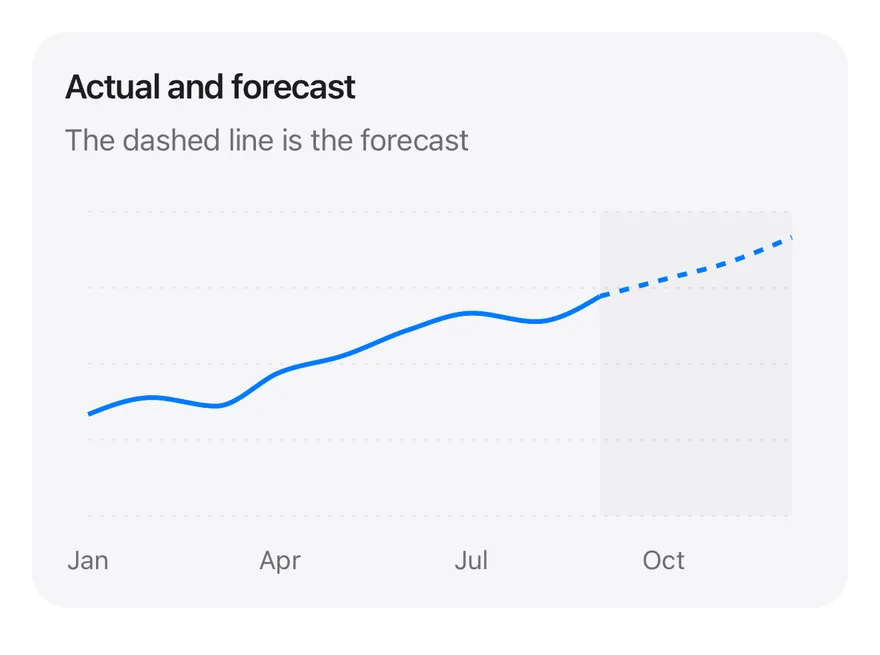
A twelve-month line with actual values in solid and a forecast in dashed, over a shaded future range.
Line Chart Forecast is an open-source mobile chart from suiss/uim, drawn with react-native-svg for React Native and Expo, with SwiftUI and Jetpack Compose versions built from the same design tokens. The @esuiss/uim CLI copies its source into your project, so you own the code.
Source: https://uim.suiss.app/docs/charts/line-chart-forecast
```tsx title="uniwind/components/charts/line-chart-forecast.tsx"
import {
Card,
CardContent,
CardDescription,
CardHeader,
CardTitle,
} from "@/components/ui/card"
import {
CartesianGrid,
type ChartConfig,
ChartContainer,
ChartTooltip,
ChartTooltipContent,
Line,
LineChart,
ReferenceArea,
XAxis,
} from "@/components/ui/chart"
const MONTHS = [
"Jan",
"Feb",
"Mar",
"Apr",
"May",
"Jun",
"Jul",
"Aug",
"Sep",
"Oct",
"Nov",
"Dec",
]
const actual = [12, 14, 13, 17, 19, 22, 24, 23, 26]
const forecast = [26, 28, 30, 33]
const chartData = MONTHS.map((month, index) => ({
month,
actual: actual[index] ?? null,
forecast: index >= 8 ? (forecast[index - 8] ?? null) : null,
}))
const chartConfig = {
actual: { label: "Actual", color: "blue" },
forecast: { label: "Forecast", color: "blue" },
} satisfies ChartConfig
export function LineChartForecast() {
return (
Actual and forecast
The dashed line is the forecast
} />
)
}
```
```swift title="swift/Charts/LineChartForecast.swift"
import Charts
import SwiftUI
private let actual: [Double] = [12, 14, 13, 17, 19, 22, 24, 23, 26]
private let forecast: [Double] = [26, 28, 30, 33]
private let months = ["Jan", "Feb", "Mar", "Apr", "May", "Jun", "Jul", "Aug", "Sep", "Oct", "Nov", "Dec"]
private let chartConfig: ChartConfig = [
"actual": .init("Actual", color: .blue),
"forecast": .init("Forecast", color: .blue),
]
private func value(_ key: String, _ index: Int) -> Double? {
if key == "actual" { return actual.indices.contains(index) ? actual[index] : nil }
return index >= 8 ? forecast[index - 8] : nil
}
public struct LineChartForecast: View {
@State private var selection: Int?
public init() {}
public var body: some View {
Card(.filled, size: .sm) {
CardHeader("Actual and forecast", description: "The dashed line is the forecast")
CardContent {
ChartContainer(config: chartConfig) {
ChartAnimator { progress in
Chart {
RectangleMark(xStart: .value("Month", 8), xEnd: .value("Month", 11))
.foregroundStyle(Color.control.opacity(0.6))
ForEach(chartConfig.keys, id: \.self) { key in
ForEach(months.indices, id: \.self) { index in
if let point = value(key, index) {
LineMark(x: .value("Month", index), y: .value("Value", point), series: .value("Series", key))
.interpolationMethod(.monotone)
.lineStyle(StrokeStyle(lineWidth: 2.5, lineCap: .round, lineJoin: .round, dash: key == "forecast" ? [5, 5] : []))
.foregroundStyle(chartConfig.color(key))
}
}
if let selection, let point = value(key, selection) {
PointMark(x: .value("Month", selection), y: .value("Value", point))
.symbolSize(64)
.foregroundStyle(chartConfig.color(key))
}
}
.chartReveal(progress, x: 0...11)
}
.chartXScale(domain: 0...11, range: .plotDimension(padding: 12))
.chartXAxis { ChartAxis.x(values: [0, 3, 6, 9]) { months[$0] } }
.chartYAxis { ChartAxis.grid() }
.chartTooltip(
x: Array(months.indices),
labels: months,
selection: $selection,
accessibilityLabel: "Actual and forecast",
items: { index in
chartConfig.keys.compactMap { key in value(key, index).map { ChartTooltipItem(key, value: $0) } }
}
) { payload in
ChartTooltipContent(payload, indicator: .line)
}
}
}
.frame(height: 192)
}
}
}
}
```
```kt title="kotlin/charts/LineChartForecast.kt"
package com.esuiss.ui.charts
import androidx.compose.foundation.layout.fillMaxWidth
import androidx.compose.foundation.layout.height
import androidx.compose.runtime.Composable
import androidx.compose.ui.Modifier
import androidx.compose.ui.unit.dp
import com.esuiss.ui.components.Card
import com.esuiss.ui.components.CardContent
import com.esuiss.ui.components.CardHeader
import com.esuiss.ui.components.CardSize
import com.esuiss.ui.components.CardVariant
import com.esuiss.ui.components.ChartConfig
import com.esuiss.ui.components.ChartConfigItem
import com.esuiss.ui.components.ChartContainer
import com.esuiss.ui.components.ChartCurve
import com.esuiss.ui.components.ChartMargin
import com.esuiss.ui.components.ChartTooltipContent
import com.esuiss.ui.components.ChartTooltipIndicator
import com.esuiss.ui.components.LineChart
import com.esuiss.ui.theme.EsuissTheme
private class LineForecastRow(val month: String, val actual: Double?, val forecast: Double?)
private val actual = listOf(12.0, 14.0, 13.0, 17.0, 19.0, 22.0, 24.0, 23.0, 26.0)
private val forecast = listOf(26.0, 28.0, 30.0, 33.0)
private val chartData = listOf("Jan", "Feb", "Mar", "Apr", "May", "Jun", "Jul", "Aug", "Sep", "Oct", "Nov", "Dec")
.mapIndexed { index, month ->
LineForecastRow(month, actual.getOrNull(index), if (index >= 8) forecast[index - 8] else null)
}
private val chartConfig = ChartConfig(
"actual" to ChartConfigItem("Actual") { blue },
"forecast" to ChartConfigItem("Forecast") { blue },
)
@Composable
fun LineChartForecast(modifier: Modifier = Modifier) {
val colors = EsuissTheme.colors
Card(modifier, variant = CardVariant.Filled, size = CardSize.Sm) {
CardHeader("Actual and forecast", description = "The dashed line is the forecast")
CardContent {
ChartContainer(
chartConfig,
Modifier
.fillMaxWidth()
.height(192.dp),
) {
LineChart(
chartData,
margin = ChartMargin(top = 10.dp, right = 12.dp, bottom = 0.dp, left = 12.dp),
accessibilityLabel = "Actual and forecast",
) {
CartesianGrid(strokeDasharray = listOf(2f, 4f))
XAxis(label = { it.month }, tickMargin = 8.dp, interval = 2)
ChartTooltip { ChartTooltipContent(indicator = ChartTooltipIndicator.Line) }
ReferenceArea(8, 11, fill = colors.control, fillOpacity = 0.6f)
Line("actual", value = { it.actual }, curve = ChartCurve.Monotone, strokeWidth = 2.5.dp)
Line(
"forecast",
value = { it.forecast },
curve = ChartCurve.Monotone,
strokeWidth = 2.5.dp,
strokeDasharray = listOf(5f, 5f),
)
}
}
}
}
}
```
Two series share one axis: `actual` fills the first nine months and `forecast` continues from September, drawn with `strokeDasharray`. A `ReferenceArea` shades September to December to mark the forecast period. Missing values are `null`, so each line stops where its data ends.
## Installation
```bash title="Terminal"
npx @esuiss/uim@latest add line-chart-forecast
```
```bash title="Terminal"
npx @esuiss/uim@latest add line-chart-forecast --platform swift
```
```bash title="Terminal"
npx @esuiss/uim@latest add line-chart-forecast --platform kotlin
```
The CLI also adds what it builds on: [Card](/docs/components/card), [Chart](/docs/components/chart).
### Manual
**Uniwind**
1. Add the pieces it builds on: [Card](/docs/components/card), [Chart](/docs/components/chart).
2. Copy the source into `components/charts/line-chart-forecast.tsx`:
```tsx title="uniwind/components/charts/line-chart-forecast.tsx"
import {
Card,
CardContent,
CardDescription,
CardHeader,
CardTitle,
} from "@/components/ui/card"
import {
CartesianGrid,
type ChartConfig,
ChartContainer,
ChartTooltip,
ChartTooltipContent,
Line,
LineChart,
ReferenceArea,
XAxis,
} from "@/components/ui/chart"
const MONTHS = [
"Jan",
"Feb",
"Mar",
"Apr",
"May",
"Jun",
"Jul",
"Aug",
"Sep",
"Oct",
"Nov",
"Dec",
]
const actual = [12, 14, 13, 17, 19, 22, 24, 23, 26]
const forecast = [26, 28, 30, 33]
const chartData = MONTHS.map((month, index) => ({
month,
actual: actual[index] ?? null,
forecast: index >= 8 ? (forecast[index - 8] ?? null) : null,
}))
const chartConfig = {
actual: { label: "Actual", color: "blue" },
forecast: { label: "Forecast", color: "blue" },
} satisfies ChartConfig
export function LineChartForecast() {
return (
Actual and forecast
The dashed line is the forecast
} />
)
}
```
3. Update the import paths to match your project.
**NativeWind**
1. Add the pieces it builds on: [Card](/docs/components/card), [Chart](/docs/components/chart).
2. Copy the source into `components/charts/line-chart-forecast.tsx`:
```tsx title="nativewind/components/charts/line-chart-forecast.tsx"
import {
Card,
CardContent,
CardDescription,
CardHeader,
CardTitle,
} from "@/components/ui/card"
import {
CartesianGrid,
type ChartConfig,
ChartContainer,
ChartTooltip,
ChartTooltipContent,
Line,
LineChart,
ReferenceArea,
XAxis,
} from "@/components/ui/chart"
const MONTHS = [
"Jan",
"Feb",
"Mar",
"Apr",
"May",
"Jun",
"Jul",
"Aug",
"Sep",
"Oct",
"Nov",
"Dec",
]
const actual = [12, 14, 13, 17, 19, 22, 24, 23, 26]
const forecast = [26, 28, 30, 33]
const chartData = MONTHS.map((month, index) => ({
month,
actual: actual[index] ?? null,
forecast: index >= 8 ? (forecast[index - 8] ?? null) : null,
}))
const chartConfig = {
actual: { label: "Actual", color: "blue" },
forecast: { label: "Forecast", color: "blue" },
} satisfies ChartConfig
export function LineChartForecast() {
return (
Actual and forecast
The dashed line is the forecast
} />
)
}
```
3. Update the import paths to match your project.
**StyleSheet**
1. Add the pieces it builds on: [Card](/docs/components/card), [Chart](/docs/components/chart).
2. Copy the source into `components/charts/line-chart-forecast.tsx`:
```tsx title="stylesheet/components/charts/line-chart-forecast.tsx"
import {
Card,
CardContent,
CardDescription,
CardHeader,
CardTitle,
} from "@/components/ui/card"
import {
CartesianGrid,
type ChartConfig,
ChartContainer,
ChartTooltip,
ChartTooltipContent,
Line,
LineChart,
ReferenceArea,
XAxis,
} from "@/components/ui/chart"
const MONTHS = [
"Jan",
"Feb",
"Mar",
"Apr",
"May",
"Jun",
"Jul",
"Aug",
"Sep",
"Oct",
"Nov",
"Dec",
]
const actual = [12, 14, 13, 17, 19, 22, 24, 23, 26]
const forecast = [26, 28, 30, 33]
const chartData = MONTHS.map((month, index) => ({
month,
actual: actual[index] ?? null,
forecast: index >= 8 ? (forecast[index - 8] ?? null) : null,
}))
const chartConfig = {
actual: { label: "Actual", color: "blue" },
forecast: { label: "Forecast", color: "blue" },
} satisfies ChartConfig
export function LineChartForecast() {
return (
Actual and forecast
The dashed line is the forecast
} />
)
}
```
3. Update the import paths to match your project.
**SwiftUI**
1. Target iOS 17 or later.
2. Copy the theme files every view uses:
```swift title="swift/Theme/Theme.swift"
import SwiftUI
import UIKit
struct RGBA: Sendable {
let red: CGFloat
let green: CGFloat
let blue: CGFloat
let alpha: CGFloat
init(_ hex: UInt32, _ alpha: CGFloat = 1) {
red = CGFloat((hex >> 16) & 0xFF) / 255
green = CGFloat((hex >> 8) & 0xFF) / 255
blue = CGFloat(hex & 0xFF) / 255
self.alpha = alpha
}
var uiColor: UIColor {
UIColor(red: red, green: green, blue: blue, alpha: alpha)
}
}
extension Color {
static func adaptive(light: RGBA, dark: RGBA) -> Color {
let lightColor = light.uiColor
let darkColor = dark.uiColor
return Color(uiColor: UIColor { traits in
traits.userInterfaceStyle == .dark ? darkColor : lightColor
})
}
}
public struct TextStyle: Sendable, Hashable {
public let size: CGFloat
public let lineHeight: CGFloat
public let letterSpacing: CGFloat
public init(size: CGFloat, lineHeight: CGFloat, letterSpacing: CGFloat) {
self.size = size
self.lineHeight = lineHeight
self.letterSpacing = letterSpacing
}
public func font(weight: Font.Weight = .regular) -> Font {
.system(size: size, weight: weight)
}
public var lineSpacing: CGFloat {
max(0, lineHeight - UIFont.systemFont(ofSize: size).lineHeight)
}
}
extension Hashable where Self == Font {
public static func textStyle(_ style: TextStyle, weight: Font.Weight = .regular) -> Font {
style.font(weight: weight)
}
}
private struct TextStyleModifier: ViewModifier {
let style: TextStyle
let weight: Font.Weight
func body(content: Content) -> some View {
content
.font(style.font(weight: weight))
.tracking(style.letterSpacing)
.lineSpacing(style.lineSpacing)
.padding(.vertical, style.lineSpacing / 2)
}
}
extension View {
public func textStyle(_ style: TextStyle, weight: Font.Weight = .regular) -> some View {
modifier(TextStyleModifier(style: style, weight: weight))
}
}
public struct Shadow: Sendable, Hashable {
public let color: Color
public let radius: CGFloat
public let x: CGFloat
public let y: CGFloat
public init(color: Color, radius: CGFloat, x: CGFloat = 0, y: CGFloat = 0) {
self.color = color
self.radius = radius
self.x = x
self.y = y
}
}
extension View {
public func shadow(_ shadow: Shadow) -> some View {
self.shadow(color: shadow.color, radius: shadow.radius, x: shadow.x, y: shadow.y)
}
}
```
```swift title="swift/Theme/Tokens.swift"
import SwiftUI
extension Color {
public static let surface = Color.adaptive(light: .init(0xFFFFFF), dark: .init(0x000000))
public static let surfaceSecondary = Color.adaptive(light: .init(0xF5F5F7), dark: .init(0x161617))
public static let surfaceTertiary = Color.adaptive(light: .init(0xE8E8ED), dark: .init(0x2C2C2E))
public static let surfaceRaised = Color.adaptive(light: .init(0xFFFFFF), dark: .init(0x1D1D1F))
public static let label = Color.adaptive(light: .init(0x1D1D1F), dark: .init(0xF5F5F7))
public static let labelSecondary = Color.adaptive(light: .init(0x6E6E73), dark: .init(0xA1A1A6))
public static let labelTertiary = Color.adaptive(light: .init(0x86868B), dark: .init(0x86868B))
public static let labelQuaternary = Color.adaptive(light: .init(0xD2D2D7), dark: .init(0x424245))
public static let control = Color.adaptive(light: .init(0x000000, 0.04), dark: .init(0xFFFFFF, 0.1))
public static let controlPressed = Color.adaptive(light: .init(0x000000, 0.12), dark: .init(0xFFFFFF, 0.22))
public static let controlSelected = Color.adaptive(light: .init(0x1D1D1F), dark: .init(0xF5F5F7))
public static let controlDisabled = Color.adaptive(light: .init(0x000000, 0.03), dark: .init(0xFFFFFF, 0.05))
public static let onControlSelected = Color.adaptive(light: .init(0xFFFFFF), dark: .init(0x000000))
public static let itemPressed = Color.adaptive(light: .init(0x000000, 0.08), dark: .init(0xFFFFFF, 0.12))
public static let itemSelected = Color.adaptive(light: .init(0x000000, 0.06), dark: .init(0xFFFFFF, 0.1))
public static let separator = Color.adaptive(light: .init(0xD2D2D7), dark: .init(0x424245))
public static let separatorStrong = Color.adaptive(light: .init(0x86868B), dark: .init(0x6E6E73))
public static let accent = Color.adaptive(light: .init(0x0071E3), dark: .init(0x0071E3))
public static let accentPressed = Color.adaptive(light: .init(0x005BB8), dark: .init(0x004D9E))
public static let accentSelected = Color.adaptive(light: .init(0x0071E3), dark: .init(0x0071E3))
public static let accentDisabled = Color.adaptive(light: .init(0x0071E3, 0.4), dark: .init(0x0071E3, 0.4))
public static let onAccent = Color.adaptive(light: .init(0xFFFFFF), dark: .init(0xFFFFFF))
public static let accentSurface = Color.adaptive(light: .init(0x0071E3, 0.09), dark: .init(0x0071E3, 0.18))
public static let accentSurfacePressed = Color.adaptive(light: .init(0x0071E3, 0.18), dark: .init(0x0071E3, 0.3))
public static let link = Color.adaptive(light: .init(0x0066CC), dark: .init(0x2997FF))
public static let focus = Color.adaptive(light: .init(0x0071E3), dark: .init(0x0071E3))
public static let scrim = Color.adaptive(light: .init(0x000000, 0.48), dark: .init(0x000000, 0.48))
public static let media = Color.adaptive(light: .init(0x000000), dark: .init(0x000000))
public static let onMedia = Color.adaptive(light: .init(0xFFFFFF), dark: .init(0xFFFFFF))
public static let danger = Color.adaptive(light: .init(0xD0000A), dark: .init(0xFF5447))
public static let dangerSurface = Color.adaptive(light: .init(0xD70015, 0.08), dark: .init(0xFF453A, 0.2))
public static let dangerSurfacePressed = Color.adaptive(light: .init(0xD70015, 0.16), dark: .init(0xFF453A, 0.36))
public static let success = Color.adaptive(light: .init(0x008009), dark: .init(0x30D158))
public static let successSurface = Color.adaptive(light: .init(0xEFFAF1), dark: .init(0x30D158, 0.16))
public static let warning = Color.adaptive(light: .init(0xB64400), dark: .init(0xFF9F0A))
public static let warningSurface = Color.adaptive(light: .init(0xFFF5EA), dark: .init(0xFF9F0A, 0.16))
}
public enum Radius {
public static let xs: CGFloat = 3
public static let sm: CGFloat = 5
public static let md: CGFloat = 8
public static let lg: CGFloat = 10
public static let xl: CGFloat = 12
public static let xl2: CGFloat = 18
public static let xl3: CGFloat = 28
public static let full: CGFloat = 9999
}
extension TextStyle {
public static let xs3 = TextStyle(size: 11, lineHeight: 13, letterSpacing: 0.066)
public static let xs2 = TextStyle(size: 12, lineHeight: 16, letterSpacing: 0)
public static let xs = TextStyle(size: 13, lineHeight: 18, letterSpacing: -0.078)
public static let sm = TextStyle(size: 15, lineHeight: 20, letterSpacing: -0.24)
public static let md = TextStyle(size: 16, lineHeight: 21, letterSpacing: -0.32)
public static let base = TextStyle(size: 17, lineHeight: 22, letterSpacing: -0.442)
public static let lg = TextStyle(size: 20, lineHeight: 25, letterSpacing: -0.46)
public static let xl = TextStyle(size: 22, lineHeight: 28, letterSpacing: -0.264)
public static let xl2 = TextStyle(size: 28, lineHeight: 34, letterSpacing: 0.392)
public static let xl3 = TextStyle(size: 34, lineHeight: 41, letterSpacing: 0.408)
public static let allCases: [TextStyle] = [.xs3, .xs2, .xs, .sm, .md, .base, .lg, .xl, .xl2, .xl3]
}
extension Shadow {
public static let md = Shadow(color: .black.opacity(0.08), radius: 6, x: 2, y: 4)
public static let lg = Shadow(color: .black.opacity(0.12), radius: 12, y: 4)
}
```
3. Copy the source and every file it uses:
```swift title="swift/Charts/LineChartForecast.swift"
import Charts
import SwiftUI
private let actual: [Double] = [12, 14, 13, 17, 19, 22, 24, 23, 26]
private let forecast: [Double] = [26, 28, 30, 33]
private let months = ["Jan", "Feb", "Mar", "Apr", "May", "Jun", "Jul", "Aug", "Sep", "Oct", "Nov", "Dec"]
private let chartConfig: ChartConfig = [
"actual": .init("Actual", color: .blue),
"forecast": .init("Forecast", color: .blue),
]
private func value(_ key: String, _ index: Int) -> Double? {
if key == "actual" { return actual.indices.contains(index) ? actual[index] : nil }
return index >= 8 ? forecast[index - 8] : nil
}
public struct LineChartForecast: View {
@State private var selection: Int?
public init() {}
public var body: some View {
Card(.filled, size: .sm) {
CardHeader("Actual and forecast", description: "The dashed line is the forecast")
CardContent {
ChartContainer(config: chartConfig) {
ChartAnimator { progress in
Chart {
RectangleMark(xStart: .value("Month", 8), xEnd: .value("Month", 11))
.foregroundStyle(Color.control.opacity(0.6))
ForEach(chartConfig.keys, id: \.self) { key in
ForEach(months.indices, id: \.self) { index in
if let point = value(key, index) {
LineMark(x: .value("Month", index), y: .value("Value", point), series: .value("Series", key))
.interpolationMethod(.monotone)
.lineStyle(StrokeStyle(lineWidth: 2.5, lineCap: .round, lineJoin: .round, dash: key == "forecast" ? [5, 5] : []))
.foregroundStyle(chartConfig.color(key))
}
}
if let selection, let point = value(key, selection) {
PointMark(x: .value("Month", selection), y: .value("Value", point))
.symbolSize(64)
.foregroundStyle(chartConfig.color(key))
}
}
.chartReveal(progress, x: 0...11)
}
.chartXScale(domain: 0...11, range: .plotDimension(padding: 12))
.chartXAxis { ChartAxis.x(values: [0, 3, 6, 9]) { months[$0] } }
.chartYAxis { ChartAxis.grid() }
.chartTooltip(
x: Array(months.indices),
labels: months,
selection: $selection,
accessibilityLabel: "Actual and forecast",
items: { index in
chartConfig.keys.compactMap { key in value(key, index).map { ChartTooltipItem(key, value: $0) } }
}
) { payload in
ChartTooltipContent(payload, indicator: .line)
}
}
}
.frame(height: 192)
}
}
}
}
```
```swift title="swift/Components/Card.swift"
import SwiftUI
public struct Card: View {
public enum Variant: CaseIterable, Sendable {
case `default`, filled
}
public enum Size: CaseIterable, Sendable {
case `default`, sm
var spacing: CGFloat {
switch self {
case .default: 24
case .sm: 16
}
}
}
let variant: Variant
let size: Size
let content: Content
@Environment(\.colorScheme) private var colorScheme
public init(
_ variant: Variant = .default,
size: Size = .default,
@ViewBuilder content: () -> Content
) {
self.variant = variant
self.size = size
self.content = content()
}
public var body: some View {
let shape = RoundedRectangle(cornerRadius: Radius.xl2, style: .continuous)
VStack(alignment: .leading, spacing: size.spacing) {
content
}
.padding(.vertical, size.spacing)
.frame(maxWidth: .infinity, alignment: .leading)
.environment(\.cardSpacing, size.spacing)
.font(TextStyle.base.font())
.tracking(TextStyle.base.letterSpacing)
.foregroundStyle(Color.label)
.background(variant == .filled ? Color.surfaceSecondary : .surfaceRaised, in: shape)
.clipShape(shape)
.overlay {
if variant == .default {
shape.strokeBorder(Color.label.opacity(colorScheme == .dark ? 0.1 : 0.05))
}
}
.shadow(variant == .default ? .md : Shadow(color: .clear, radius: 0))
}
}
extension EnvironmentValues {
@Entry var cardSpacing: CGFloat = 24
}
public struct CardHeader: View {
let title: LocalizedStringKey
let description: LocalizedStringKey?
let action: Action
@Environment(\.cardSpacing) private var spacing
public init(
_ title: LocalizedStringKey,
description: LocalizedStringKey? = nil,
@ViewBuilder action: () -> Action
) {
self.title = title
self.description = description
self.action = action()
}
public var body: some View {
HStack(alignment: .top, spacing: 6) {
VStack(alignment: .leading, spacing: 6) {
CardTitle(title)
if let description {
CardDescription(description)
}
}
.frame(maxWidth: .infinity, alignment: .leading)
action
}
.padding(.horizontal, spacing)
}
}
extension CardHeader where Action == EmptyView {
public init(_ title: LocalizedStringKey, description: LocalizedStringKey? = nil) {
self.init(title, description: description) { EmptyView() }
}
}
public struct CardTitle: View {
let title: LocalizedStringKey
public init(_ title: LocalizedStringKey) {
self.title = title
}
public var body: some View {
Text(title)
.textStyle(.base, weight: .semibold)
.foregroundStyle(Color.label)
}
}
public struct CardDescription: View {
let text: LocalizedStringKey
public init(_ text: LocalizedStringKey) {
self.text = text
}
public var body: some View {
Text(text)
.textStyle(.sm)
.foregroundStyle(Color.labelSecondary)
}
}
public struct CardContent: View {
let content: Content
@Environment(\.cardSpacing) private var spacing
public init(@ViewBuilder content: () -> Content) {
self.content = content()
}
public var body: some View {
VStack(alignment: .leading, spacing: 0) {
content
}
.frame(maxWidth: .infinity, alignment: .leading)
.padding(.horizontal, spacing)
}
}
public struct CardFooter: View {
let content: Content
@Environment(\.cardSpacing) private var spacing
public init(@ViewBuilder content: () -> Content) {
self.content = content()
}
public var body: some View {
HStack(spacing: 0) {
content
}
.frame(maxWidth: .infinity, alignment: .leading)
.padding(.horizontal, spacing)
}
}
```
```swift title="swift/Components/Chart.swift"
import Charts
import SwiftUI
public struct ChartConfig: ExpressibleByDictionaryLiteral, Sendable {
public struct Item: Sendable {
public var label: String?
public var color: Color?
public var icon: Image?
public init(_ label: String? = nil, color: Color? = nil, icon: Image? = nil) {
self.label = label
self.color = color
self.icon = icon
}
}
public let keys: [String]
private let items: [String: Item]
public init(_ elements: [(String, Item)]) {
keys = elements.map(\.0)
items = Dictionary(elements, uniquingKeysWith: { _, last in last })
}
public init(dictionaryLiteral elements: (String, Item)...) {
self.init(elements)
}
public subscript(key: String) -> Item? {
items[key]
}
public func label(_ key: String) -> String {
items[key]?.label ?? key
}
public func color(_ key: String) -> Color {
items[key]?.color ?? .labelTertiary
}
}
extension EnvironmentValues {
@Entry var chartConfig = ChartConfig([])
}
public struct ChartContainer: View {
let config: ChartConfig
let content: Content
public init(config: ChartConfig, @ViewBuilder content: () -> Content) {
self.config = config
self.content = content()
}
public var body: some View {
VStack(spacing: 0) {
content
}
.frame(maxWidth: .infinity)
.environment(\.chartConfig, config)
.font(TextStyle.xs.font())
.foregroundStyle(Color.label)
}
}
public enum ChartAnimationEasing: CaseIterable, Sendable {
case ease, easeIn, easeOut, easeInOut, linear
public func animation(duration: Double) -> Animation {
let seconds = duration / 1000
return switch self {
case .ease: .timingCurve(0.25, 0.1, 0.25, 1, duration: seconds)
case .easeIn: .timingCurve(0.42, 0, 1, 1, duration: seconds)
case .easeOut: .timingCurve(0, 0, 0.58, 1, duration: seconds)
case .easeInOut: .timingCurve(0.42, 0, 0.58, 1, duration: seconds)
case .linear: .linear(duration: seconds)
}
}
var curve: UnitCurve {
switch self {
case .ease: .bezier(startControlPoint: UnitPoint(x: 0.25, y: 0.1), endControlPoint: UnitPoint(x: 0.25, y: 1))
case .easeIn: .bezier(startControlPoint: UnitPoint(x: 0.42, y: 0), endControlPoint: UnitPoint(x: 1, y: 1))
case .easeOut: .bezier(startControlPoint: UnitPoint(x: 0, y: 0), endControlPoint: UnitPoint(x: 0.58, y: 1))
case .easeInOut: .bezier(startControlPoint: UnitPoint(x: 0.42, y: 0), endControlPoint: UnitPoint(x: 0.58, y: 1))
case .linear: .linear
}
}
}
extension EnvironmentValues {
@Entry var chartAnimationActive = true
}
public struct ChartAnimator: View {
let isAnimationActive: Bool
let animationDuration: Double
let animationEasing: ChartAnimationEasing
let content: (Double) -> Content
@State private var start: Date?
@State private var finished = false
@Environment(\.chartAnimationActive) private var allowed
@Environment(\.accessibilityReduceMotion) private var reduceMotion
public init(
isAnimationActive: Bool = true,
animationDuration: Double = 1500,
animationEasing: ChartAnimationEasing = .ease,
@ViewBuilder content: @escaping (Double) -> Content
) {
self.isAnimationActive = isAnimationActive
self.animationDuration = animationDuration
self.animationEasing = animationEasing
self.content = content
}
private var animates: Bool {
isAnimationActive && allowed && !reduceMotion && !finished
}
private var running: Bool {
animates && start != nil
}
public var body: some View {
TimelineView(.animation(minimumInterval: nil, paused: !running)) { context in
content(progress(at: context.date))
}
.onAppear {
if animates && start == nil {
start = .now
}
}
.task(id: running) {
guard running else { return }
do {
try await Task.sleep(for: .milliseconds(Int(animationDuration)))
finished = true
} catch {}
}
}
private func progress(at date: Date) -> Double {
guard animates else { return 1 }
guard let start else { return 0 }
let time = min(max(date.timeIntervalSince(start) * 1000 / max(animationDuration, 1), 0), 1)
return animationEasing.curve.value(at: time)
}
}
struct ChartDataAnimation: ViewModifier {
let isAnimationActive: Bool
let animationDuration: Double
let animationEasing: ChartAnimationEasing
let value: Value
@Environment(\.chartAnimationActive) private var allowed
@Environment(\.accessibilityReduceMotion) private var reduceMotion
func body(content: Content) -> some View {
if isAnimationActive && allowed && !reduceMotion {
content.animation(animationEasing.animation(duration: animationDuration), value: value)
} else {
content
}
}
}
struct ChartRevealContent: ChartContent {
let content: Content
let progress: Double
let start: X
let end: X
var body: some ChartContent {
if progress < 1 {
content.mask {
RectangleMark(xStart: .value("Reveal", start), xEnd: .value("Reveal", end))
.offset(xStart: -16, yStart: -16, yEnd: 16)
}
} else {
content
}
}
}
extension ChartContent {
public func chartReveal(_ progress: Double, x domain: ClosedRange) -> some ChartContent {
ChartRevealContent(
content: self, progress: progress, start: domain.lowerBound,
end: domain.lowerBound + (domain.upperBound - domain.lowerBound) * min(max(progress, 0), 1)
)
}
public func chartReveal(_ progress: Double, x domain: ClosedRange) -> some ChartContent {
chartReveal(progress, x: Double(domain.lowerBound)...Double(domain.upperBound))
}
public func chartReveal(_ progress: Double, x domain: ClosedRange) -> some ChartContent {
ChartRevealContent(
content: self, progress: progress, start: domain.lowerBound,
end: domain.lowerBound.addingTimeInterval(
domain.upperBound.timeIntervalSince(domain.lowerBound) * min(max(progress, 0), 1)
)
)
}
}
public struct ChartAnchorMark: ChartContent {
let x: PlottableValue
let y: PlottableValue
public init(x: PlottableValue, y: PlottableValue) {
self.x = x
self.y = y
}
public var body: some ChartContent {
PointMark(x: x, y: y)
.symbolSize(0)
.opacity(0)
}
}
public struct ChartSectorRest: ChartContent {
let value: Double
public init(total: Double, progress: Double) {
value = total * (1 - min(max(progress, 0), 1))
}
public var body: some ChartContent {
if value > 0 {
SectorMark(angle: .value("Rest", value))
.foregroundStyle(Color.clear)
}
}
}
public enum ChartAxis {
public static func x(
values: [Value],
format: @escaping (Value) -> String = { "\($0)" }
) -> some AxisContent {
AxisMarks(values: values) { value in
label(value, format: format, anchor: .top)
}
}
public static func y(
values: [Value],
edge: HorizontalEdge = .trailing,
grid: Bool = true,
emphasized: Bool = false,
format: @escaping (Value) -> String = { "\($0)" }
) -> some AxisContent {
let position: AxisMarkPosition = edge == .leading ? .leading : .trailing
let categorical = Value.self == String.self
return AxisMarks(preset: categorical ? .extended : .automatic, position: position, values: values) { value in
if grid {
gridLine()
}
label(value, format: format, emphasized: emphasized, centered: categorical ? true : nil)
}
}
public static func y(
count: Int,
edge: HorizontalEdge = .trailing,
grid: Bool = true,
format: @escaping (Double) -> String = { $0.formatted() }
) -> some AxisContent {
AxisMarks(position: edge == .leading ? .leading : .trailing, values: .automatic(desiredCount: count)) { value in
if grid {
gridLine()
}
label(value, format: format)
}
}
public static func grid(values: [Double]) -> some AxisContent {
AxisMarks(values: values) { _ in
gridLine()
}
}
public static func grid(count: Int = 5) -> some AxisContent {
AxisMarks(values: .automatic(desiredCount: count)) { _ in
gridLine()
}
}
static func gridLine() -> some AxisMark {
AxisGridLine(stroke: StrokeStyle(lineWidth: 1, dash: [2, 4]))
.foregroundStyle(Color.separator.opacity(0.5))
}
static func label(
_ value: AxisValue,
format: @escaping (Value) -> String,
emphasized: Bool = false,
anchor: UnitPoint? = nil,
centered: Bool? = nil
) -> some AxisMark {
AxisValueLabel(centered: centered, anchor: anchor, collisionResolution: .disabled) {
if let plotted = value.as(Value.self) {
Text(verbatim: format(plotted))
.font(TextStyle.xs.font(weight: emphasized ? .semibold : .regular))
.foregroundStyle(emphasized ? Color.label : .labelSecondary)
}
}
}
}
public struct ChartTooltipItem: Identifiable, Sendable {
public let key: String
public let value: Double
public var color: Color?
public var id: String { key }
public init(_ key: String, value: Double, color: Color? = nil) {
self.key = key
self.value = value
self.color = color
}
}
public struct ChartTooltipPayload: Sendable {
public let index: Int
public let label: String
public let items: [ChartTooltipItem]
public init(index: Int, label: String, items: [ChartTooltipItem]) {
self.index = index
self.label = label
self.items = items
}
public var total: Double {
items.reduce(0) { $0 + $1.value }
}
}
public enum ChartTooltipIndicator: CaseIterable, Sendable {
case dot, line, dashed
}
public struct ChartTooltipContent: View {
let payload: ChartTooltipPayload
let indicator: ChartTooltipIndicator
let hideLabel: Bool
let hideIndicator: Bool
let labelFormatter: ((ChartTooltipPayload) -> LabelContent)?
let formatter: ((ChartTooltipItem) -> ValueContent)?
@Environment(\.chartConfig) private var config
@Environment(\.colorScheme) private var colorScheme
public init(
_ payload: ChartTooltipPayload,
indicator: ChartTooltipIndicator = .dot,
hideLabel: Bool = false,
hideIndicator: Bool = false,
@ViewBuilder labelFormatter: @escaping (ChartTooltipPayload) -> LabelContent,
@ViewBuilder formatter: @escaping (ChartTooltipItem) -> ValueContent
) {
self.payload = payload
self.indicator = indicator
self.hideLabel = hideLabel
self.hideIndicator = hideIndicator
self.labelFormatter = labelFormatter
self.formatter = formatter
}
public var body: some View {
let nest = payload.items.count == 1 && indicator != .dot
let shape = RoundedRectangle(cornerRadius: Radius.md, style: .continuous)
VStack(alignment: .leading, spacing: 6) {
if !nest {
title
}
VStack(alignment: .leading, spacing: 6) {
ForEach(payload.items) { item in
row(item, nest: nest)
}
}
}
.font(TextStyle.xs.font())
.foregroundStyle(Color.label)
.padding(.horizontal, 10)
.padding(.vertical, 6)
.frame(minWidth: 128, alignment: .leading)
.background(Color.surfaceRaised, in: shape)
.overlay {
shape.strokeBorder(Color.label.opacity(colorScheme == .dark ? 0.1 : 0.05))
}
.shadow(.lg)
.fixedSize()
}
@ViewBuilder private var title: some View {
if !hideLabel {
if let labelFormatter {
labelFormatter(payload)
.font(TextStyle.xs.font(weight: .semibold))
} else {
let value = config[payload.label]?.label ?? payload.label
if !value.isEmpty {
Text(LocalizedStringKey(value))
.font(TextStyle.xs.font(weight: .semibold))
}
}
}
}
@ViewBuilder private func row(_ item: ChartTooltipItem, nest: Bool) -> some View {
if let formatter {
HStack(spacing: 8) {
formatter(item)
}
.frame(maxWidth: .infinity, alignment: .leading)
} else {
HStack(alignment: indicator == .dot ? .center : .top, spacing: 8) {
if let icon = config[item.key]?.icon {
icon
.resizable()
.frame(width: 10, height: 10)
.foregroundStyle(Color.labelSecondary)
} else if !hideIndicator {
ChartTooltipIndicatorMark(indicator: indicator, color: item.color ?? config.color(item.key), nest: nest)
}
HStack(alignment: nest ? .bottom : .center, spacing: 8) {
VStack(alignment: .leading, spacing: 6) {
if nest {
title
}
Text(LocalizedStringKey(config.label(item.key)))
.foregroundStyle(Color.labelSecondary)
}
Spacer(minLength: 8)
Text(item.value, format: .number)
.font(TextStyle.xs.font(weight: .semibold))
.monospacedDigit()
.foregroundStyle(Color.label)
}
}
.fixedSize(horizontal: false, vertical: true)
}
}
}
extension ChartTooltipContent where LabelContent == EmptyView {
public init(
_ payload: ChartTooltipPayload,
indicator: ChartTooltipIndicator = .dot,
hideLabel: Bool = false,
hideIndicator: Bool = false,
@ViewBuilder formatter: @escaping (ChartTooltipItem) -> ValueContent
) {
self.payload = payload
self.indicator = indicator
self.hideLabel = hideLabel
self.hideIndicator = hideIndicator
labelFormatter = nil
self.formatter = formatter
}
}
extension ChartTooltipContent where ValueContent == EmptyView {
public init(
_ payload: ChartTooltipPayload,
indicator: ChartTooltipIndicator = .dot,
hideLabel: Bool = false,
hideIndicator: Bool = false,
@ViewBuilder labelFormatter: @escaping (ChartTooltipPayload) -> LabelContent
) {
self.payload = payload
self.indicator = indicator
self.hideLabel = hideLabel
self.hideIndicator = hideIndicator
self.labelFormatter = labelFormatter
formatter = nil
}
}
extension ChartTooltipContent where LabelContent == EmptyView, ValueContent == EmptyView {
public init(
_ payload: ChartTooltipPayload,
indicator: ChartTooltipIndicator = .dot,
hideLabel: Bool = false,
hideIndicator: Bool = false
) {
self.payload = payload
self.indicator = indicator
self.hideLabel = hideLabel
self.hideIndicator = hideIndicator
labelFormatter = nil
formatter = nil
}
}
struct ChartTooltipIndicatorMark: View {
let indicator: ChartTooltipIndicator
let color: Color
let nest: Bool
var body: some View {
switch indicator {
case .dot:
RoundedRectangle(cornerRadius: Radius.xs / 1.5, style: .continuous)
.fill(color)
.frame(width: 10, height: 10)
case .line:
RoundedRectangle(cornerRadius: Radius.xs / 1.5, style: .continuous)
.fill(color)
.frame(width: 4)
.frame(maxHeight: .infinity)
case .dashed:
ChartDashedLine()
.stroke(color, style: StrokeStyle(lineWidth: 1.5, dash: [3, 2]))
.frame(width: 1.5)
.frame(maxHeight: .infinity)
.padding(.vertical, nest ? 2 : 0)
}
}
}
struct ChartDashedLine: Shape {
func path(in rect: CGRect) -> Path {
var path = Path()
path.move(to: CGPoint(x: rect.midX, y: rect.minY))
path.addLine(to: CGPoint(x: rect.midX, y: rect.maxY))
return path
}
}
public struct ChartLegendContent: View {
let keys: [String]?
let hideIcon: Bool
@Environment(\.chartConfig) private var config
public init(keys: [String]? = nil, hideIcon: Bool = false) {
self.keys = keys
self.hideIcon = hideIcon
}
public var body: some View {
let shown = config.keys.filter { key in
keys.map { $0.contains(key) } ?? (config[key]?.color != nil)
}
ChartLegendLayout(horizontalSpacing: 16, verticalSpacing: 6) {
ForEach(shown, id: \.self) { key in
HStack(spacing: 6) {
if let icon = config[key]?.icon, !hideIcon {
icon
.resizable()
.frame(width: 12, height: 12)
.foregroundStyle(Color.labelSecondary)
} else {
RoundedRectangle(cornerRadius: Radius.xs / 1.5, style: .continuous)
.fill(config.color(key))
.frame(width: 8, height: 8)
}
Text(LocalizedStringKey(config.label(key)))
.font(TextStyle.xs.font())
.foregroundStyle(Color.label)
}
.accessibilityElement(children: .combine)
}
}
.frame(maxWidth: .infinity)
.padding(.top, 12)
}
}
struct ChartLegendLayout: Layout {
var horizontalSpacing: CGFloat
var verticalSpacing: CGFloat
var centered = true
func sizeThatFits(proposal: ProposedViewSize, subviews: Subviews, cache: inout ()) -> CGSize {
let rows = arrange(width: proposal.width ?? .infinity, subviews: subviews)
let width = rows.map(\.width).max() ?? 0
let height = rows.map(\.height).reduce(0, +) + verticalSpacing * CGFloat(max(rows.count - 1, 0))
return CGSize(width: proposal.width ?? width, height: height)
}
func placeSubviews(in bounds: CGRect, proposal: ProposedViewSize, subviews: Subviews, cache: inout ()) {
var y = bounds.minY
for row in arrange(width: bounds.width, subviews: subviews) {
var x = bounds.minX + (centered ? max(0, (bounds.width - row.width) / 2) : 0)
for index in row.indices {
let size = subviews[index].sizeThatFits(.unspecified)
subviews[index].place(
at: CGPoint(x: x, y: y + (row.height - size.height) / 2),
anchor: .topLeading,
proposal: ProposedViewSize(size)
)
x += size.width + horizontalSpacing
}
y += row.height + verticalSpacing
}
}
private struct Row {
var indices: [Int] = []
var width: CGFloat = 0
var height: CGFloat = 0
}
private func arrange(width: CGFloat, subviews: Subviews) -> [Row] {
var rows: [Row] = []
var row = Row()
for index in subviews.indices {
let size = subviews[index].sizeThatFits(.unspecified)
let next = row.indices.isEmpty ? size.width : row.width + horizontalSpacing + size.width
if !row.indices.isEmpty && next > width {
rows.append(row)
row = Row()
}
row.width = row.indices.isEmpty ? size.width : row.width + horizontalSpacing + size.width
row.height = max(row.height, size.height)
row.indices.append(index)
}
if !row.indices.isEmpty { rows.append(row) }
return rows
}
}
enum ChartSelectionAxis {
case x, y, angle, radius, spoke
}
struct ChartTooltipModifier: ViewModifier {
let axis: ChartSelectionAxis
let values: [Value]
let labels: [String]
let external: Binding?
let cursor: Bool
let sticky: Bool
let summary: String?
let items: (Int) -> [ChartTooltipItem]
let tooltip: (ChartTooltipPayload) -> Tooltip
let rotation: Angle
let sweep: Angle
let hit: ((CGPoint, CGSize) -> Int?)?
let radius: ClosedRange
@State private var owned: Int?
@State private var raw: Value?
@State private var press: ChartPress?
@State private var size = CGSize.zero
@State private var outside = false
@Environment(\.chartConfig) private var config
@Environment(\.locale) private var locale
init(
axis: ChartSelectionAxis,
values: [Value],
labels: [String]?,
selection: Binding?,
defaultIndex: Int?,
cursor: Bool,
sticky: Bool,
summary: String?,
items: @escaping (Int) -> [ChartTooltipItem],
tooltip: @escaping (ChartTooltipPayload) -> Tooltip,
rotation: Angle = .zero,
sweep: Angle = .degrees(360),
hit: ((CGPoint, CGSize) -> Int?)? = nil,
radius: ClosedRange = 0...1
) {
self.axis = axis
self.radius = radius
self.rotation = rotation
self.sweep = sweep
self.hit = hit
self.values = values
self.labels = labels ?? values.map { "\($0)" }
external = selection
self.cursor = cursor
self.sticky = sticky
self.summary = summary
self.items = items
self.tooltip = tooltip
_owned = State(initialValue: defaultIndex)
}
private var selection: Int? {
let value = external?.wrappedValue ?? owned
guard let value, values.indices.contains(value) else { return nil }
return value
}
private func select(_ index: Int?) {
if let external {
external.wrappedValue = index
} else {
owned = index
}
}
func body(content: Content) -> some View {
decorated(content)
.hapticFeedback(.selection, trigger: selection, condition: HapticMoments.lifted)
.accessibilityElement(children: .ignore)
.accessibilityLabel(Text(verbatim: accessibilityLabel))
.accessibilityValue(Text(verbatim: accessibilityValue))
.accessibilityAdjustableAction { direction in
switch direction {
case .increment:
select(min(values.count - 1, (selection ?? -1) + 1))
case .decrement:
select(max(0, (selection ?? values.count) - 1))
@unknown default:
break
}
}
}
@ViewBuilder private func decorated(_ content: Content) -> some View {
switch axis {
case .x, .y:
cartesian(content)
case .angle:
content
.rotationEffect(rotation)
.onGeometryChange(for: CGSize.self) { $0.size } action: { size = $0 }
.gesture(
DragGesture(minimumDistance: 0)
.onChanged { gesture in
if let index = sector(at: gesture.location) {
hold(index)
} else if press == nil {
outside = true
}
}
.onEnded { _ in
if outside && press == nil {
select(nil)
} else {
release()
}
outside = false
}
)
.overlay(alignment: .topLeading) {
polarTooltip
}
case .radius, .spoke:
content
.onGeometryChange(for: CGSize.self) { $0.size } action: { size = $0 }
.contentShape(Rectangle())
.gesture(
DragGesture(minimumDistance: 0)
.onChanged { gesture in
if let index = hit?(gesture.location, size) {
hold(index)
} else if press == nil {
outside = true
}
}
.onEnded { _ in
if outside && press == nil {
select(nil)
} else {
release()
}
outside = false
}
)
.overlay(alignment: .topLeading) {
polarTooltip
}
}
}
@ViewBuilder private var polarTooltip: some View {
if let index = selection {
ChartTooltipLayout(anchor: CGPoint(x: trailing(index) ? 1 : 0, y: 0), axis: .angle) {
tooltip(payload(index))
}
.allowsHitTesting(false)
}
}
private func sector(at location: CGPoint) -> Int? {
let dx = location.x - size.width / 2
let dy = location.y - size.height / 2
let distance = hypot(dx, dy) / max(min(size.width, size.height) / 2, 1)
guard radius.contains(distance) else { return nil }
let numbers = values.map { Self.number($0) ?? 0 }
let total = numbers.reduce(0, +)
let span = abs(sweep.radians)
guard total > 0, span > 0 else { return nil }
var angle = (atan2(Double(dx), Double(-dy)) - rotation.radians).truncatingRemainder(dividingBy: 2 * .pi)
if angle < 0 { angle += 2 * .pi }
guard angle <= span + 0.0001 else { return nil }
let target = angle / span * total
var sum = 0.0
for (index, number) in numbers.enumerated() {
sum += number
if target <= sum { return index }
}
return numbers.indices.last
}
private func trailing(_ index: Int) -> Bool {
if axis == .spoke {
return sin(2 * .pi * Double(index) / Double(max(values.count, 1))) < -0.0001
}
guard axis == .angle else { return false }
let numbers = values.map { Self.number($0) ?? 0 }
let total = numbers.reduce(0, +)
guard total > 0 else { return false }
let before = numbers.prefix(index).reduce(0, +)
let middle = rotation.radians + sweep.radians * (before + numbers[index] / 2) / total
return sin(middle) < -0.0001
}
private func cartesian(_ content: Content) -> some View {
selectable(content)
.onChange(of: raw) { _, value in
update(value)
}
.chartBackground { proxy in
GeometryReader { geometry in
if cursor, axis == .x, let index = selection, let frame = proxy.plotFrame,
let x = proxy.position(forX: values[index])
{
let plot = geometry[frame]
Rectangle()
.fill(Color.separator)
.frame(width: 1, height: plot.height)
.position(x: plot.minX + x, y: plot.midY)
}
}
}
.chartOverlay(alignment: .topLeading) { proxy in
GeometryReader { geometry in
if let index = selection, let frame = proxy.plotFrame {
let plot = geometry[frame]
ChartTooltipLayout(anchor: anchor(index, proxy: proxy, plot: plot), axis: axis) {
tooltip(payload(index))
}
.allowsHitTesting(false)
}
}
}
}
@ViewBuilder private func selectable(_ content: Content) -> some View {
if axis == .y {
content.chartYSelection(value: $raw)
} else {
content.chartXSelection(value: $raw)
}
}
private func payload(_ index: Int) -> ChartTooltipPayload {
ChartTooltipPayload(index: index, label: labels[index], items: items(index))
}
private func anchor(_ index: Int, proxy: ChartProxy, plot: CGRect) -> CGPoint {
switch axis {
case .x:
CGPoint(x: plot.minX + (proxy.position(forX: values[index]) ?? 0), y: 0)
case .y:
CGPoint(x: plot.maxX, y: plot.minY + (proxy.position(forY: values[index]) ?? 0))
case .angle, .radius, .spoke:
.zero
}
}
private func update(_ value: Value?) {
guard let value else {
release()
return
}
guard let index = index(of: value) else { return }
hold(index)
}
private func release() {
if let press, !press.moved, press.wasSelected {
select(nil)
} else if !sticky {
select(nil)
}
press = nil
}
private func hold(_ index: Int) {
if var current = press {
if index != current.start {
current.moved = true
press = current
}
} else {
press = ChartPress(start: index, wasSelected: selection == index)
}
select(index)
}
private func index(of value: Value) -> Int? {
if let index = values.firstIndex(of: value) { return index }
guard let target = Self.number(value) else { return nil }
return values.indices.min { lhs, rhs in
abs((Self.number(values[lhs]) ?? .infinity) - target) < abs((Self.number(values[rhs]) ?? .infinity) - target)
}
}
private static func number(_ value: Value) -> Double? {
switch value.primitivePlottable as Any {
case let number as Double: number
case let number as Int: Double(number)
case let number as Float: Double(number)
case let number as CGFloat: Double(number)
case let date as Date: date.timeIntervalSinceReferenceDate
default: nil
}
}
private var accessibilityLabel: String {
var parts: [String] = []
if let summary { parts.append(summary) }
if let first = labels.first, let last = labels.last, labels.count > 1 {
parts.append("\(first) – \(last)")
}
return parts.joined(separator: ", ")
}
private var accessibilityValue: String {
guard let index = selection else { return "" }
let entries = items(index).map { item in
"\(config.label(item.key)) \(item.value.formatted(.number.locale(locale)))"
}
return "\(labels[index]): \(entries.joined(separator: ", "))"
}
}
struct ChartPress: Equatable {
var start: Int
var wasSelected: Bool
var moved = false
}
struct ChartTooltipLayout: Layout {
var anchor: CGPoint
var axis: ChartSelectionAxis
func sizeThatFits(proposal: ProposedViewSize, subviews: Subviews, cache: inout ()) -> CGSize {
proposal.replacingUnspecifiedDimensions()
}
func placeSubviews(in bounds: CGRect, proposal: ProposedViewSize, subviews: Subviews, cache: inout ()) {
guard let view = subviews.first else { return }
let size = view.sizeThatFits(.unspecified)
let origin: CGPoint
switch axis {
case .x:
origin = CGPoint(
x: min(max(bounds.minX, bounds.minX + anchor.x - size.width / 2), bounds.maxX - size.width),
y: bounds.minY
)
case .y:
origin = CGPoint(
x: bounds.minX + anchor.x - size.width,
y: min(max(bounds.minY, bounds.minY + anchor.y - size.height / 2), bounds.maxY - size.height)
)
case .angle, .radius, .spoke:
origin = CGPoint(x: anchor.x > 0 ? bounds.maxX - size.width : bounds.minX, y: bounds.minY)
}
view.place(at: origin, anchor: .topLeading, proposal: ProposedViewSize(size))
}
}
extension View {
public func chartTooltip(
x values: [Value],
labels: [String]? = nil,
selection: Binding? = nil,
defaultIndex: Int? = nil,
cursor: Bool = true,
sticky: Bool = true,
accessibilityLabel: String? = nil,
items: @escaping (Int) -> [ChartTooltipItem],
@ViewBuilder content: @escaping (ChartTooltipPayload) -> Tooltip
) -> some View {
modifier(
ChartTooltipModifier(
axis: .x, values: values, labels: labels, selection: selection, defaultIndex: defaultIndex,
cursor: cursor, sticky: sticky, summary: accessibilityLabel, items: items, tooltip: content
)
)
}
public func chartTooltip(
y values: [Value],
labels: [String]? = nil,
selection: Binding? = nil,
defaultIndex: Int? = nil,
sticky: Bool = true,
accessibilityLabel: String? = nil,
items: @escaping (Int) -> [ChartTooltipItem],
@ViewBuilder content: @escaping (ChartTooltipPayload) -> Tooltip
) -> some View {
modifier(
ChartTooltipModifier(
axis: .y, values: values, labels: labels, selection: selection, defaultIndex: defaultIndex,
cursor: false, sticky: sticky, summary: accessibilityLabel, items: items, tooltip: content
)
)
}
public func chartTooltip(
angle values: [Double],
labels: [String],
startAngle: Angle = .zero,
endAngle: Angle = .degrees(360),
innerRadius: CGFloat = 0,
outerRadius: CGFloat = 1,
selection: Binding? = nil,
defaultIndex: Int? = nil,
sticky: Bool = true,
accessibilityLabel: String? = nil,
items: @escaping (Int) -> [ChartTooltipItem],
@ViewBuilder content: @escaping (ChartTooltipPayload) -> Tooltip
) -> some View {
modifier(
ChartTooltipModifier(
axis: .angle, values: values, labels: labels, selection: selection, defaultIndex: defaultIndex,
cursor: false, sticky: sticky, summary: accessibilityLabel, items: items, tooltip: content,
rotation: startAngle, sweep: endAngle - startAngle, radius: innerRadius...outerRadius
)
)
}
}
public struct RadialBar: Identifiable, Sendable {
public let key: String
public let value: Double
public var color: Color?
public var id: String { key }
public init(_ key: String, value: Double, color: Color? = nil) {
self.key = key
self.value = value
self.color = color
}
}
public enum RadialBarTrack: CaseIterable, Sendable {
case none, control, tint
}
public struct RadialBarChart: View {
let bars: [RadialBar]
let domain: ClosedRange?
let innerRadius: CGFloat
let outerRadius: CGFloat
let barSize: CGFloat?
let startAngle: Angle
let endAngle: Angle
let rounded: Bool
let track: RadialBarTrack
let showsLabels: Bool
let interactive: Bool
let selection: Binding?
let defaultIndex: Int?
let sticky: Bool
let summary: String?
let isAnimationActive: Bool
let animationDuration: Double
let animationEasing: ChartAnimationEasing
let tooltip: (ChartTooltipPayload) -> Tooltip
@Environment(\.chartConfig) private var config
public init(
_ bars: [RadialBar],
domain: ClosedRange? = nil,
innerRadius: CGFloat = 0,
outerRadius: CGFloat = 0.8,
barSize: CGFloat? = nil,
startAngle: Angle = .degrees(90),
endAngle: Angle = .degrees(-270),
rounded: Bool = false,
track: RadialBarTrack = .none,
showsLabels: Bool = false,
selection: Binding? = nil,
defaultIndex: Int? = nil,
sticky: Bool = true,
accessibilityLabel: String? = nil,
isAnimationActive: Bool = true,
animationDuration: Double = 1500,
animationEasing: ChartAnimationEasing = .ease,
@ViewBuilder tooltip: @escaping (ChartTooltipPayload) -> Tooltip
) {
self.bars = bars
self.domain = domain
self.innerRadius = innerRadius
self.outerRadius = outerRadius
self.barSize = barSize
self.startAngle = startAngle
self.endAngle = endAngle
self.rounded = rounded
self.track = track
self.showsLabels = showsLabels
interactive = true
self.selection = selection
self.defaultIndex = defaultIndex
self.sticky = sticky
summary = accessibilityLabel
self.isAnimationActive = isAnimationActive
self.animationDuration = animationDuration
self.animationEasing = animationEasing
self.tooltip = tooltip
}
public var body: some View {
let canvas = ChartAnimator(
isAnimationActive: isAnimationActive, animationDuration: animationDuration, animationEasing: animationEasing
) { progress in
GeometryReader { geometry in
let layout = RadialBarLayout(chart: self, size: geometry.size)
ZStack {
ForEach(bars.indices, id: \.self) { index in
let color = bars[index].color ?? config.color(bars[index].key)
let ring = layout.ring(index)
if track != .none {
ChartArc(
center: layout.center, radius: ring.middle, thickness: ring.thickness,
start: startAngle, end: endAngle, rounded: rounded
)
.fill(track == .tint ? color.opacity(0.22) : Color.control)
}
ChartSweep(
arc: ChartArc(
center: layout.center, radius: ring.middle, thickness: ring.thickness,
start: startAngle, end: layout.angle(layout.low + (bars[index].value - layout.low) * progress),
rounded: rounded
)
)
.fill(color)
}
if showsLabels && progress >= 1 {
ForEach(bars.indices, id: \.self) { index in
ForEach(layout.glyphs(String(localized: String.LocalizationValue(config.label(bars[index].key))), ring: index), id: \.offset) { glyph in
Text(verbatim: glyph.text)
.font(TextStyle.xs2.font(weight: .semibold))
.foregroundStyle(Color.onAccent)
.fixedSize()
.rotationEffect(glyph.rotation)
.position(glyph.point)
}
}
.allowsHitTesting(false)
}
}
}
}
.modifier(
ChartDataAnimation(
isAnimationActive: isAnimationActive, animationDuration: animationDuration, animationEasing: animationEasing,
value: bars.map(\.value)
)
)
if interactive {
canvas
.modifier(
ChartTooltipModifier(
axis: .radius, values: bars.map(\.value), labels: bars.map { config.label($0.key) },
selection: selection, defaultIndex: defaultIndex, cursor: false, sticky: sticky, summary: summary,
items: { [ChartTooltipItem(bars[$0].key, value: bars[$0].value, color: bars[$0].color)] },
tooltip: tooltip,
hit: { location, size in RadialBarLayout(chart: self, size: size).index(at: location) }
)
)
} else {
canvas
.accessibilityHidden(true)
}
}
}
extension RadialBarChart where Tooltip == EmptyView {
public init(
_ bars: [RadialBar],
domain: ClosedRange? = nil,
innerRadius: CGFloat = 0,
outerRadius: CGFloat = 0.8,
barSize: CGFloat? = nil,
startAngle: Angle = .degrees(90),
endAngle: Angle = .degrees(-270),
rounded: Bool = false,
track: RadialBarTrack = .none,
isAnimationActive: Bool = true,
animationDuration: Double = 1500,
animationEasing: ChartAnimationEasing = .ease
) {
self.bars = bars
self.domain = domain
self.innerRadius = innerRadius
self.outerRadius = outerRadius
self.barSize = barSize
self.startAngle = startAngle
self.endAngle = endAngle
self.rounded = rounded
self.track = track
showsLabels = false
interactive = false
selection = nil
defaultIndex = nil
sticky = true
summary = nil
self.isAnimationActive = isAnimationActive
self.animationDuration = animationDuration
self.animationEasing = animationEasing
tooltip = { _ in EmptyView() }
}
}
struct RadialBarLayout {
struct Ring {
var middle: CGFloat
var thickness: CGFloat
}
let center: CGPoint
let inner: CGFloat
let band: CGFloat
let thickness: CGFloat
let count: Int
let low: Double
let high: Double
let start: Angle
let end: Angle
init(chart: RadialBarChart, size: CGSize) {
let margin: CGFloat = 5
let maxRadius = max(0, min(size.width, size.height) / 2 - margin)
center = CGPoint(x: size.width / 2, y: size.height / 2)
inner = maxRadius * chart.innerRadius
count = max(chart.bars.count, 1)
band = (maxRadius * chart.outerRadius - inner) / CGFloat(count)
thickness = chart.barSize ?? max(1, band * 0.8)
low = chart.domain?.lowerBound ?? 0
high = chart.domain?.upperBound ?? Self.niceMax(chart.bars.map(\.value).max() ?? 1)
start = chart.startAngle
end = chart.endAngle
}
func ring(_ index: Int) -> Ring {
Ring(middle: inner + band * (CGFloat(index) + 0.5), thickness: thickness)
}
func angle(_ value: Double) -> Angle {
let ratio = high > low ? (value - low) / (high - low) : 0
return start + (end - start) * min(max(ratio, 0), 1)
}
struct Glyph {
var offset: Int
var text: String
var point: CGPoint
var rotation: Angle
}
func glyphs(_ label: String, ring index: Int) -> [Glyph] {
let middle = max(ring(index).middle, 1)
let font = UIFont.systemFont(ofSize: TextStyle.xs2.size, weight: .semibold)
let direction: Double = end.degrees >= start.degrees ? 1 : -1
var distance = 5 + thickness / 2
return Array(label).enumerated().map { offset, character in
let text = String(character)
let width = (text as NSString).size(withAttributes: [.font: font]).width
let angle = start.radians + direction * Double(distance + width / 2) / Double(middle)
distance += width
return Glyph(
offset: offset,
text: text,
point: ChartArc.point(center: center, radius: middle, angle: angle),
rotation: .radians(direction > 0 ? angle : angle + .pi)
)
}
}
func index(at location: CGPoint) -> Int? {
let distance = hypot(location.x - center.x, location.y - center.y)
let position = (distance - inner) / max(band, 1)
guard position >= 0 else { return nil }
let index = Int(position)
return index < count ? index : nil
}
static func niceMax(_ value: Double) -> Double {
guard value > 0 else { return 1 }
var correction = 0.0
while correction < 20 {
let rough = value / 4
let digits = floor(log10(rough)) + 1
let unit = pow(10, digits)
let ratio = rough / unit
let scale = digits != 1 ? 0.05 : 0.1
let step = ((ratio / scale).rounded(.up) * scale + correction * scale) * unit
let ups = (value / step).rounded(.up)
if ups + 1 <= 5 { return ups * step }
correction += 1
}
return value
}
}
struct ChartSweep: Shape {
var arc: ChartArc
var animatableData: AnimatablePair {
get { AnimatablePair(arc.start.radians, arc.end.radians) }
set {
arc.start = .radians(newValue.first)
arc.end = .radians(newValue.second)
}
}
func path(in rect: CGRect) -> Path {
arc.path(in: rect)
}
}
struct ChartArc: Shape {
var center: CGPoint
var radius: CGFloat
var thickness: CGFloat
var start: Angle
var end: Angle
var rounded: Bool
static func point(center: CGPoint, radius: CGFloat, angle: Double) -> CGPoint {
CGPoint(x: center.x + radius * CGFloat(sin(angle)), y: center.y - radius * CGFloat(cos(angle)))
}
func path(in rect: CGRect) -> Path {
let sweep = end.radians - start.radians
guard radius > 0, abs(sweep) > 0.0001 else { return Path() }
let full = abs(sweep) >= 2 * .pi - 0.0001
let cap = rounded && !full ? Double(thickness / 2 / radius) : 0
let direction: Double = sweep >= 0 ? 1 : -1
var from = start.radians + direction * cap
var to = end.radians - direction * cap
if (to - from) * direction < 0 {
from = (start.radians + end.radians) / 2
to = from
}
var line = Path()
let steps = max(2, Int(abs(to - from) / (.pi / 180)) + 1)
for step in 0...steps {
let angle = from + (to - from) * Double(step) / Double(steps)
let point = Self.point(center: center, radius: radius, angle: angle)
if step == 0 {
line.move(to: point)
} else {
line.addLine(to: point)
}
}
if full {
line.closeSubpath()
}
return line.strokedPath(StrokeStyle(lineWidth: thickness, lineCap: rounded ? .round : .butt, lineJoin: .round))
}
}
public enum PolarGridType: CaseIterable, Sendable {
case polygon, circle
}
public struct PolarGrid: Sendable {
public var gridType: PolarGridType
public var stroke: Color
public var strokeWidth: CGFloat
public var fill: Color?
public var fillOpacity: Double
public init(
gridType: PolarGridType = .polygon,
stroke: Color = .separator,
strokeWidth: CGFloat = 1,
fill: Color? = nil,
fillOpacity: Double = 1
) {
self.gridType = gridType
self.stroke = stroke
self.strokeWidth = strokeWidth
self.fill = fill
self.fillOpacity = fillOpacity
}
}
public struct PolarAngleAxis: Sendable {
public var textStyle: TextStyle
public var highlightsSelection: Bool
public init(textStyle: TextStyle = .xs, highlightsSelection: Bool = false) {
self.textStyle = textStyle
self.highlightsSelection = highlightsSelection
}
}
public struct PolarRadiusAxis: Sendable {
public var angle: Angle
public var tickCount: Int
public init(angle: Angle, tickCount: Int = 5) {
self.angle = angle
self.tickCount = tickCount
}
}
public struct Radar: Identifiable, Sendable {
public let key: String
public let values: [Double]
public var color: Color?
public var fillOpacity: Double
public var strokeWidth: CGFloat
public var strokeOpacity: Double
public var dot: CGFloat?
public var id: String { key }
public init(
_ key: String,
values: [Double],
color: Color? = nil,
fillOpacity: Double = 0.3,
strokeWidth: CGFloat = 2,
strokeOpacity: Double = 1,
dot: CGFloat? = nil
) {
self.key = key
self.values = values
self.color = color
self.fillOpacity = fillOpacity
self.strokeWidth = strokeWidth
self.strokeOpacity = strokeOpacity
self.dot = dot
}
}
public struct RadarChart: View {
let series: [Radar]
let labels: [String]
let domain: ClosedRange?
let outerRadius: CGFloat
let center: UnitPoint
let margin: EdgeInsets
let grid: PolarGrid?
let angleAxis: PolarAngleAxis
let radiusAxis: PolarRadiusAxis?
let selection: Binding?
let sticky: Bool
let summary: String?
let items: ((Int) -> [ChartTooltipItem])?
let isAnimationActive: Bool
let animationDuration: Double
let animationEasing: ChartAnimationEasing
let tooltip: (ChartTooltipPayload) -> Tooltip
@State private var owned: Int?
@Environment(\.chartConfig) private var config
public init(
_ series: [Radar],
labels: [String],
domain: ClosedRange? = nil,
outerRadius: CGFloat = 0.8,
center: UnitPoint = .center,
margin: EdgeInsets = EdgeInsets(top: 5, leading: 5, bottom: 5, trailing: 5),
grid: PolarGrid? = PolarGrid(),
angleAxis: PolarAngleAxis = PolarAngleAxis(),
radiusAxis: PolarRadiusAxis? = nil,
selection: Binding? = nil,
defaultIndex: Int? = nil,
sticky: Bool = true,
accessibilityLabel: String? = nil,
items: ((Int) -> [ChartTooltipItem])? = nil,
isAnimationActive: Bool = true,
animationDuration: Double = 1500,
animationEasing: ChartAnimationEasing = .ease,
@ViewBuilder tooltip: @escaping (ChartTooltipPayload) -> Tooltip
) {
self.series = series
self.labels = labels
self.domain = domain
self.outerRadius = outerRadius
self.center = center
self.margin = margin
self.grid = grid
self.angleAxis = angleAxis
self.radiusAxis = radiusAxis
self.selection = selection
self.sticky = sticky
summary = accessibilityLabel
self.items = items
self.isAnimationActive = isAnimationActive
self.animationDuration = animationDuration
self.animationEasing = animationEasing
self.tooltip = tooltip
_owned = State(initialValue: defaultIndex)
}
private var current: Int? {
guard let value = selection?.wrappedValue ?? owned, labels.indices.contains(value) else { return nil }
return value
}
public var body: some View {
ChartAnimator(
isAnimationActive: isAnimationActive, animationDuration: animationDuration, animationEasing: animationEasing
) { progress in
GeometryReader { geometry in
let layout = RadarLayout(chart: self, size: geometry.size)
ZStack(alignment: .topLeading) {
if let grid {
gridView(grid, layout: layout)
}
if let index = current {
ChartSpokes(center: layout.center, radius: layout.outer, angles: [layout.angle(index)])
.stroke(Color.separatorStrong, lineWidth: 1)
}
ForEach(series) { radar in
let color = radar.color ?? config.color(radar.key)
let ratios = ChartVector(values: radar.values.map { layout.ratio($0) * progress })
ZStack {
RadarPolygon(center: layout.center, radius: layout.outer, ratios: ratios)
.fill(color)
.opacity(radar.fillOpacity)
if radar.strokeWidth > 0 {
RadarPolygon(center: layout.center, radius: layout.outer, ratios: ratios)
.stroke(color, style: StrokeStyle(lineWidth: radar.strokeWidth, lineJoin: .round))
.opacity(radar.strokeOpacity)
}
}
}
ForEach(series) { radar in
if let dot = radar.dot {
let color = radar.color ?? config.color(radar.key)
ForEach(radar.values.indices, id: \.self) { index in
Circle()
.fill(color)
.frame(width: (dot + radar.strokeWidth / 2) * 2, height: (dot + radar.strokeWidth / 2) * 2)
.position(layout.point(index, ratio: layout.ratio(radar.values[index]) * progress))
.opacity(radar.strokeOpacity)
}
}
}
if let index = current {
ForEach(series) { radar in
if radar.values.indices.contains(index) {
Circle()
.fill(radar.color ?? config.color(radar.key))
.frame(width: 8, height: 8)
.position(layout.point(index, ratio: layout.ratio(radar.values[index]) * progress))
.opacity(radar.strokeOpacity)
}
}
}
if let radiusAxis {
ChartPointLayout(placements: layout.radiusTicks(radiusAxis)) {
ForEach(layout.radiusValues(radiusAxis), id: \.self) { value in
Text(verbatim: value.formatted())
.font(TextStyle.xs2.font())
.foregroundStyle(Color.labelTertiary)
.fixedSize()
}
}
}
ChartPointLayout(placements: labels.indices.map(layout.labelPlacement)) {
ForEach(labels.indices, id: \.self) { index in
let active = angleAxis.highlightsSelection && current == index
Text(LocalizedStringKey(labels[index]))
.font(angleAxis.textStyle.font(weight: active ? .semibold : .regular))
.foregroundStyle(active ? Color.label : .labelSecondary)
.fixedSize()
}
}
}
.frame(width: geometry.size.width, height: geometry.size.height)
}
}
.modifier(
ChartDataAnimation(
isAnimationActive: isAnimationActive, animationDuration: animationDuration, animationEasing: animationEasing,
value: series.map(\.values)
)
)
.modifier(
ChartTooltipModifier(
axis: .spoke, values: labels.indices.map(Double.init), labels: labels,
selection: selection ?? $owned, defaultIndex: nil, cursor: false, sticky: sticky, summary: summary,
items: items ?? { index in
series.compactMap { radar in
radar.values.indices.contains(index)
? ChartTooltipItem(radar.key, value: radar.values[index], color: radar.color) : nil
}
},
tooltip: tooltip,
hit: { location, size in RadarLayout(chart: self, size: size).index(at: location) }
)
)
}
@ViewBuilder private func gridView(_ grid: PolarGrid, layout: RadarLayout) -> some View {
let circle = grid.gridType == .circle
let radii = layout.gridRadii(radiusAxis?.tickCount ?? 5)
if let fill = grid.fill {
ChartRings(center: layout.center, radii: [radii.max() ?? 0], count: layout.count, circle: circle)
.fill(fill)
.opacity(grid.fillOpacity)
}
ChartRings(center: layout.center, radii: radii, count: layout.count, circle: circle)
.stroke(grid.stroke, lineWidth: grid.strokeWidth)
ChartSpokes(center: layout.center, radius: layout.outer, angles: (0..(chart: RadarChart, size: CGSize) {
let plot = CGRect(
x: chart.margin.leading,
y: chart.margin.top,
width: max(0, size.width - chart.margin.leading - chart.margin.trailing),
height: max(0, size.height - chart.margin.top - chart.margin.bottom)
)
center = CGPoint(x: plot.minX + plot.width * chart.center.x, y: plot.minY + plot.height * chart.center.y)
outer = min(plot.width, plot.height) / 2 * chart.outerRadius
count = max(chart.labels.count, 1)
low = chart.domain?.lowerBound ?? 0
high = chart.domain?.upperBound ?? RadialBarLayout.niceMax(chart.series.flatMap(\.values).max() ?? 1)
}
func angle(_ index: Int) -> Double {
2 * .pi * Double(index) / Double(count)
}
func ratio(_ value: Double) -> Double {
high > low ? max(0, (value - low) / (high - low)) : 0
}
func point(_ index: Int, ratio: Double) -> CGPoint {
ChartArc.point(center: center, radius: outer * CGFloat(ratio), angle: angle(index))
}
func gridRadii(_ ticks: Int) -> [CGFloat] {
let steps = max(ticks - 1, 1)
return (0...steps).map { outer * CGFloat($0) / CGFloat(steps) }
}
func radiusValues(_ axis: PolarRadiusAxis) -> [Double] {
let steps = max(axis.tickCount - 1, 1)
return (0...steps).map { low + (high - low) * Double($0) / Double(steps) }
}
func radiusTicks(_ axis: PolarRadiusAxis) -> [ChartPointLayout.Placement] {
gridRadii(axis.tickCount).map { radius in
ChartPointLayout.Placement(
point: ChartArc.point(center: center, radius: radius, angle: axis.angle.radians),
anchor: .bottomLeading
)
}
}
func labelPlacement(_ index: Int) -> ChartPointLayout.Placement {
let angle = angle(index)
let horizontal = sin(angle)
let vertical = cos(angle)
let x: CGFloat = horizontal > 0.00001 ? 0 : horizontal < -0.00001 ? 1 : 0.5
let y: CGFloat = abs(horizontal) <= 0.5.squareRoot() ? (vertical > 0 ? 1 : 0) : 0.5
return ChartPointLayout.Placement(
point: ChartArc.point(center: center, radius: outer + 8, angle: angle),
anchor: UnitPoint(x: x, y: y)
)
}
func index(at location: CGPoint) -> Int? {
var angle = atan2(Double(location.x - center.x), Double(center.y - location.y))
if angle < 0 { angle += 2 * .pi }
return Int((angle / (2 * .pi / Double(count))).rounded()) % count
}
}
struct ChartPointLayout: Layout {
struct Placement {
var point: CGPoint
var anchor: UnitPoint
}
var placements: [Placement]
func sizeThatFits(proposal: ProposedViewSize, subviews: Subviews, cache: inout ()) -> CGSize {
proposal.replacingUnspecifiedDimensions()
}
func placeSubviews(in bounds: CGRect, proposal: ProposedViewSize, subviews: Subviews, cache: inout ()) {
for (index, subview) in subviews.enumerated() where placements.indices.contains(index) {
let placement = placements[index]
subview.place(
at: CGPoint(x: bounds.minX + placement.point.x, y: bounds.minY + placement.point.y),
anchor: placement.anchor,
proposal: .unspecified
)
}
}
}
struct ChartVector: VectorArithmetic {
var values: [Double]
static var zero: ChartVector { ChartVector(values: []) }
static func + (lhs: ChartVector, rhs: ChartVector) -> ChartVector {
combine(lhs, rhs, +)
}
static func - (lhs: ChartVector, rhs: ChartVector) -> ChartVector {
combine(lhs, rhs, -)
}
mutating func scale(by rhs: Double) {
values = values.map { $0 * rhs }
}
var magnitudeSquared: Double {
values.reduce(0) { $0 + $1 * $1 }
}
private static func combine(_ lhs: ChartVector, _ rhs: ChartVector, _ operation: (Double, Double) -> Double) -> ChartVector {
let count = max(lhs.values.count, rhs.values.count)
return ChartVector(values: (0.. Path {
let count = ratios.values.count
guard count > 0 else { return Path() }
var path = Path()
for (index, ratio) in ratios.values.enumerated() {
let point = ChartArc.point(
center: center, radius: radius * CGFloat(max(ratio, 0)), angle: 2 * .pi * Double(index) / Double(count)
)
if index == 0 {
path.move(to: point)
} else {
path.addLine(to: point)
}
}
path.closeSubpath()
return path
}
}
struct ChartRings: Shape {
var center: CGPoint
var radii: [CGFloat]
var count: Int
var circle: Bool
func path(in rect: CGRect) -> Path {
var path = Path()
for radius in radii where radius > 0 {
if circle {
path.addEllipse(in: CGRect(x: center.x - radius, y: center.y - radius, width: radius * 2, height: radius * 2))
} else {
for index in 0.. Path {
var path = Path()
for angle in angles {
path.move(to: center)
path.addLine(to: ChartArc.point(center: center, radius: radius, angle: angle))
}
return path
}
}
```
```swift title="swift/Components/Haptics.swift"
import SwiftUI
extension EnvironmentValues {
@Entry public var hapticsEnabled = true
}
extension View {
public func haptics(_ enabled: Bool) -> some View {
environment(\.hapticsEnabled, enabled)
}
func hapticFeedback(_ feedback: SensoryFeedback, trigger: Trigger) -> some View {
modifier(HapticFeedbackModifier(feedback: feedback, trigger: trigger) { _, _ in true })
}
func hapticFeedback(
_ feedback: SensoryFeedback,
trigger: Trigger,
condition: @escaping (Trigger, Trigger) -> Bool
) -> some View {
modifier(HapticFeedbackModifier(feedback: feedback, trigger: trigger, condition: condition))
}
}
private struct HapticFeedbackModifier: ViewModifier {
let feedback: SensoryFeedback
let trigger: Trigger
let condition: (Trigger, Trigger) -> Bool
@Environment(\.hapticsEnabled) private var enabled
func body(content: Content) -> some View {
let enabled = enabled
let condition = condition
content.sensoryFeedback(feedback, trigger: trigger) { old, new in
enabled && condition(old, new)
}
}
}
enum HapticMoments {
static func step(_ value: Double, bounds: ClosedRange, step: Double?) -> Int? {
guard let step, step > 0 else { return nil }
return Int(((value - bounds.lowerBound) / step).rounded())
}
static func lifted(_ old: Value?, _ new: Value?) -> Bool {
new != nil && old != new
}
static func crossed(_ old: Value?, _ new: Value?) -> Bool {
old == nil && new != nil
}
static func moved(_ old: Int?, _ new: Int?) -> Bool {
guard let old, let new else { return false }
return old != new
}
}
struct HapticButton: View {
let feedback: SensoryFeedback
let action: () -> Bool
let style: Style
@State private var count = 0
init(_ feedback: SensoryFeedback = .selection, style: Style, action: @escaping () -> Bool) {
self.feedback = feedback
self.style = style
self.action = action
}
var body: some View {
Button {
if action() { count += 1 }
} label: {
EmptyView()
}
.buttonStyle(style)
.hapticFeedback(feedback, trigger: count)
}
}
```
```swift title="swift/Components/Item.swift"
import SwiftUI
public enum ItemVariant: CaseIterable, Sendable {
case `default`, outline, muted
}
public enum ItemSize: CaseIterable, Sendable {
case `default`, sm, xs
var horizontalPadding: CGFloat {
switch self {
case .default: 16
case .sm: 14
case .xs: 12
}
}
var verticalPadding: CGFloat {
switch self {
case .default: 14
case .sm: 12
case .xs: 10
}
}
var gap: CGFloat {
self == .xs ? 10 : 14
}
var groupGap: CGFloat {
switch self {
case .default: 16
case .sm: 10
case .xs: 8
}
}
var mediaImage: CGFloat {
switch self {
case .default: 40
case .sm: 32
case .xs: 24
}
}
}
public enum ItemGroupVariant: CaseIterable, Sendable {
case `default`, inset
}
extension EnvironmentValues {
@Entry var itemSize: ItemSize = .default
@Entry var itemGroupInset = false
@Entry var itemHasDescription = false
}
struct ItemGapKey: PreferenceKey {
static var defaultValue: CGFloat? { nil }
static func reduce(value: inout CGFloat?, nextValue: () -> CGFloat?) {
guard let next = nextValue() else { return }
value = min(value ?? next, next)
}
}
struct ItemDescriptionKey: PreferenceKey {
static var defaultValue: Bool { false }
static func reduce(value: inout Bool, nextValue: () -> Bool) {
value = value || nextValue()
}
}
enum ItemSlot: Sendable {
case media, content, actions, fullRow, other
}
struct ItemSlotKey: LayoutValueKey {
static let defaultValue = ItemSlot.other
}
public struct ItemGroup: View {
let variant: ItemGroupVariant
let content: Content
@State private var gap: CGFloat?
public init(_ variant: ItemGroupVariant = .default, @ViewBuilder content: () -> Content) {
self.variant = variant
self.content = content()
}
public var body: some View {
let inset = variant == .inset
let shape = RoundedRectangle(cornerRadius: Radius.xl2, style: .continuous)
VStack(alignment: .leading, spacing: inset ? 0 : gap ?? ItemSize.default.groupGap) {
content
}
.frame(maxWidth: .infinity, alignment: .leading)
.environment(\.itemGroupInset, inset)
.onPreferenceChange(ItemGapKey.self) { gap = $0 }
.transformPreference(ItemGapKey.self) { $0 = nil }
.background(inset ? Color.surfaceSecondary : .clear, in: shape)
.clipShape(inset ? AnyShape(shape) : AnyShape(Rectangle()))
.accessibilityElement(children: .contain)
}
}
public struct ItemSeparator: View {
@Environment(\.itemGroupInset) private var inset
public init() {}
public var body: some View {
Separator()
.padding(.vertical, inset ? 0 : 8)
.padding(.leading, inset ? 16 : 0)
}
}
public struct Item: View {
let variant: ItemVariant
let size: ItemSize
let action: (() -> Void)?
let content: Content
@State private var hasDescription = false
@Environment(\.itemGroupInset) private var inset
public init(
_ variant: ItemVariant = .default,
size: ItemSize = .default,
action: (() -> Void)? = nil,
@ViewBuilder content: () -> Content
) {
self.variant = variant
self.size = size
self.action = action
self.content = content()
}
public var body: some View {
Group {
if let action {
Button(action: action) {
surface
}
.buttonStyle(ItemButtonStyle(variant: variant, inset: inset))
} else {
surface.background(ItemBackground(variant: variant, inset: inset, pressed: false))
}
}
.preference(key: ItemGapKey.self, value: size.groupGap)
}
private var surface: some View {
ItemLayout(gap: size.gap, topAlignMedia: hasDescription) {
content
}
.scaledFont(.base)
.foregroundStyle(Color.label)
.padding(.horizontal, size.horizontalPadding)
.padding(.vertical, size.verticalPadding)
.frame(maxWidth: .infinity, alignment: .leading)
.environment(\.itemSize, size)
.environment(\.itemHasDescription, hasDescription)
.onPreferenceChange(ItemDescriptionKey.self) { hasDescription = $0 }
.contentShape(Rectangle())
}
}
private struct ItemBackground: View {
let variant: ItemVariant
let inset: Bool
let pressed: Bool
var body: some View {
let shape = RoundedRectangle(cornerRadius: inset ? 0 : Radius.xl, style: .continuous)
ZStack {
shape.fill(variant == .muted ? Color.surfaceSecondary.opacity(0.5) : .clear)
if pressed {
shape.fill(Color.itemPressed)
}
if variant == .outline {
shape.strokeBorder(Color.separator)
}
}
}
}
private struct ItemButtonStyle: ButtonStyle {
let variant: ItemVariant
let inset: Bool
@Environment(\.isEnabled) private var isEnabled
func makeBody(configuration: Configuration) -> some View {
configuration.label
.background(ItemBackground(variant: variant, inset: inset, pressed: configuration.isPressed && isEnabled))
.opacity(isEnabled ? 1 : 0.5)
}
}
struct ItemLayout: Layout {
var gap: CGFloat
var topAlignMedia: Bool
private struct Line {
var indices: [Int]
var full: Bool
}
private func lines(_ subviews: Subviews) -> [Line] {
var result: [Line] = []
var current: [Int] = []
for index in subviews.indices {
if subviews[index][ItemSlotKey.self] == .fullRow {
if !current.isEmpty { result.append(Line(indices: current, full: false)) }
current = []
result.append(Line(indices: [index], full: true))
} else {
current.append(index)
}
}
if !current.isEmpty { result.append(Line(indices: current, full: false)) }
return result
}
private func widths(_ line: Line, subviews: Subviews, width: CGFloat?) -> [CGFloat] {
if line.full {
return [width ?? subviews[line.indices[0]].sizeThatFits(.unspecified).width]
}
let spacing = gap * CGFloat(max(line.indices.count - 1, 0))
let flexible = line.indices.first { subviews[$0][ItemSlotKey.self] == .content }
var fixed: [Int: CGFloat] = [:]
for index in line.indices where index != flexible {
fixed[index] = subviews[index].sizeThatFits(.unspecified).width
}
let used = fixed.values.reduce(0, +) + spacing
return line.indices.map { index in
if index == flexible {
if let width { return max(width - used, 0) }
return subviews[index].sizeThatFits(.unspecified).width
}
return fixed[index] ?? 0
}
}
func sizeThatFits(proposal: ProposedViewSize, subviews: Subviews, cache: inout ()) -> CGSize {
var height: CGFloat = 0
var widest: CGFloat = 0
let all = lines(subviews)
for (position, line) in all.enumerated() {
let sizes = widths(line, subviews: subviews, width: proposal.width)
var lineHeight: CGFloat = 0
for (index, width) in zip(line.indices, sizes) {
lineHeight = max(lineHeight, subviews[index].sizeThatFits(ProposedViewSize(width: width, height: nil)).height)
}
let spacing = gap * CGFloat(max(line.indices.count - 1, 0))
widest = max(widest, sizes.reduce(0, +) + (line.full ? 0 : spacing))
height += lineHeight + (position > 0 ? gap : 0)
}
return CGSize(width: proposal.width ?? widest, height: height)
}
func placeSubviews(in bounds: CGRect, proposal: ProposedViewSize, subviews: Subviews, cache: inout ()) {
var y = bounds.minY
for line in lines(subviews) {
let sizes = widths(line, subviews: subviews, width: bounds.width)
var heights: [CGFloat] = []
for (index, width) in zip(line.indices, sizes) {
heights.append(subviews[index].sizeThatFits(ProposedViewSize(width: width, height: nil)).height)
}
let lineHeight = heights.max() ?? 0
var x = bounds.minX
for (offset, index) in line.indices.enumerated() {
let width = sizes[offset]
let height = heights[offset]
let top = topAlignMedia && subviews[index][ItemSlotKey.self] == .media
let originY = top ? y + 2 : y + (lineHeight - height) / 2
subviews[index].place(
at: CGPoint(x: x, y: originY),
anchor: .topLeading,
proposal: ProposedViewSize(width: width, height: height)
)
x += width + gap
}
y += lineHeight + gap
}
}
}
public enum ItemMediaVariant: CaseIterable, Sendable {
case `default`, icon, image
}
public struct ItemMedia: View {
let variant: ItemMediaVariant
let content: Content
@Environment(\.itemSize) private var size
public init(_ variant: ItemMediaVariant = .default, @ViewBuilder content: () -> Content) {
self.variant = variant
self.content = content()
}
public var body: some View {
Group {
switch variant {
case .default:
HStack(spacing: 8) { content }
case .icon:
content.frame(width: 16, height: 16)
case .image:
content
.scaledToFill()
.frame(width: size.mediaImage, height: size.mediaImage)
.clipShape(RoundedRectangle(cornerRadius: size == .xs ? Radius.sm : Radius.md, style: .continuous))
}
}
.accessibilityHidden(variant != .default)
.layoutValue(key: ItemSlotKey.self, value: .media)
}
}
public struct ItemContent: View {
let content: Content
@Environment(\.itemSize) private var size
public init(@ViewBuilder content: () -> Content) {
self.content = content()
}
public var body: some View {
VStack(alignment: .leading, spacing: size == .xs ? 2 : 4) {
content
}
.frame(maxWidth: .infinity, alignment: .leading)
.layoutValue(key: ItemSlotKey.self, value: .content)
}
}
public struct ItemTitle: View {
let content: Content
public init(@ViewBuilder content: () -> Content) {
self.content = content()
}
public var body: some View {
HStack(spacing: 8) {
content
}
.scaledTextStyle(.base, weight: .semibold)
.foregroundStyle(Color.label)
.lineLimit(1)
.accessibilityElement(children: .combine)
}
}
extension ItemTitle where Content == Text {
public init(_ title: LocalizedStringKey) {
self.init { Text(title) }
}
public init(verbatim title: String) {
self.init { Text(verbatim: title) }
}
}
public struct ItemDescription: View {
let text: Text
public init(_ description: LocalizedStringKey) {
text = Text(description)
}
public init(verbatim description: String) {
text = Text(verbatim: description)
}
public var body: some View {
text
.scaledTextStyle(.sm)
.foregroundStyle(Color.labelSecondary)
.multilineTextAlignment(.leading)
.lineLimit(2)
.fixedSize(horizontal: false, vertical: true)
.preference(key: ItemDescriptionKey.self, value: true)
}
}
public struct ItemActions: View {
let content: Content
public init(@ViewBuilder content: () -> Content) {
self.content = content()
}
public var body: some View {
HStack(spacing: 8) {
content
}
.fixedSize()
.layoutValue(key: ItemSlotKey.self, value: .actions)
}
}
public struct ItemHeader: View {
let content: Content
public init(@ViewBuilder content: () -> Content) {
self.content = content()
}
public var body: some View {
SpaceBetween(spacing: 8) {
content
}
.frame(maxWidth: .infinity)
.layoutValue(key: ItemSlotKey.self, value: .fullRow)
}
}
public struct ItemFooter: View {
let content: Content
public init(@ViewBuilder content: () -> Content) {
self.content = content()
}
public var body: some View {
SpaceBetween(spacing: 8) {
content
}
.frame(maxWidth: .infinity)
.layoutValue(key: ItemSlotKey.self, value: .fullRow)
}
}
struct SpaceBetween: Layout {
var spacing: CGFloat
func sizeThatFits(proposal: ProposedViewSize, subviews: Subviews, cache: inout ()) -> CGSize {
let sizes = subviews.map { $0.sizeThatFits(.unspecified) }
let natural = sizes.reduce(0) { $0 + $1.width } + spacing * CGFloat(max(subviews.count - 1, 0))
return CGSize(width: proposal.width ?? natural, height: sizes.map(\.height).max() ?? 0)
}
func placeSubviews(in bounds: CGRect, proposal: ProposedViewSize, subviews: Subviews, cache: inout ()) {
let sizes = subviews.map { $0.sizeThatFits(.unspecified) }
let total = sizes.reduce(0) { $0 + $1.width }
let gaps = CGFloat(max(subviews.count - 1, 0))
let gap = subviews.count > 1 ? max(spacing, (bounds.width - total) / gaps) : 0
var x = bounds.minX
for (index, view) in subviews.enumerated() {
let size = sizes[index]
view.place(
at: CGPoint(x: x, y: bounds.midY - size.height / 2),
anchor: .topLeading,
proposal: ProposedViewSize(size)
)
x += size.width + gap
}
}
}
```
```swift title="swift/Components/Separator.swift"
import SwiftUI
public struct Separator: View {
let orientation: Axis
public init(_ orientation: Axis = .horizontal) {
self.orientation = orientation
}
public var body: some View {
Rectangle()
.fill(Color.separator)
.frame(width: orientation == .vertical ? 1 : nil, height: orientation == .horizontal ? 1 : nil)
.frame(maxWidth: orientation == .horizontal ? .infinity : nil, maxHeight: orientation == .vertical ? .infinity : nil)
.accessibilityHidden(true)
}
}
```
```swift title="swift/Components/TextVariant.swift"
import SwiftUI
public enum TextVariant: CaseIterable, Sendable {
case `default`, h1, h2, h3, h4, p, blockquote, code, lead, large, small, muted
var style: TextStyle {
switch self {
case .h1: .xl3
case .h2: .xl2
case .h3: .xl
case .h4, .lead, .large: .lg
case .code, .small, .muted: .sm
default: .base
}
}
var weight: Font.Weight {
switch self {
case .h1, .h2: .bold
case .h3, .h4, .large, .code: .semibold
case .small: .medium
default: .regular
}
}
var color: Color {
switch self {
case .lead, .muted: .labelSecondary
default: .label
}
}
var isHeading: Bool {
switch self {
case .h1, .h2, .h3, .h4: true
default: false
}
}
}
private struct TextVariantModifier: ViewModifier {
let variant: TextVariant
func body(content: Content) -> some View {
switch variant {
case .blockquote:
styled(content)
.italic()
.padding(.leading, 12)
.overlay(alignment: .leading) {
Rectangle().fill(Color.separator).frame(width: 2)
}
.padding(.top, 16)
case .code:
styled(content)
.monospaced()
.padding(.horizontal, 4)
.padding(.vertical, 2)
.background(Color.surfaceSecondary, in: RoundedRectangle(cornerRadius: Radius.sm, style: .continuous))
case .p:
styled(content).padding(.top, 12)
default:
styled(content)
}
}
private func styled(_ content: Content) -> some View {
content
.scaledTextStyle(variant.style, weight: variant.weight)
.foregroundStyle(variant.color)
.accessibilityAddTraits(variant.isHeading ? .isHeader : [])
}
}
extension View {
public func textVariant(_ variant: TextVariant) -> some View {
modifier(TextVariantModifier(variant: variant))
}
}
private struct ScaledTextStyleModifier: ViewModifier {
let style: TextStyle
let weight: Font.Weight
@ScaledMetric(relativeTo: .body) private var scale: CGFloat = 1
func body(content: Content) -> some View {
let size = style.size * scale
let lineSpacing = max(0, style.lineHeight * scale - UIFont.systemFont(ofSize: size).lineHeight)
content
.font(.system(size: size, weight: weight))
.tracking(style.letterSpacing)
.lineSpacing(lineSpacing)
.padding(.vertical, lineSpacing / 2)
}
}
extension View {
func scaledTextStyle(_ style: TextStyle, weight: Font.Weight = .regular) -> some View {
modifier(ScaledTextStyleModifier(style: style, weight: weight))
}
func scaledFont(_ style: TextStyle, weight: Font.Weight = .regular) -> some View {
modifier(ScaledFontModifier(style: style, weight: weight))
}
}
private struct ScaledFontModifier: ViewModifier {
let style: TextStyle
let weight: Font.Weight
@ScaledMetric(relativeTo: .body) private var scale: CGFloat = 1
func body(content: Content) -> some View {
content
.font(.system(size: style.size * scale, weight: weight))
.tracking(style.letterSpacing)
}
}
```
4. Add the files to your app target.
**Jetpack Compose**
1. Set `minSdk` to 24 or higher and add the dependencies:
```kotlin title="build.gradle.kts"
implementation(platform("androidx.compose:compose-bom:2026.09.00"))
implementation("androidx.compose.foundation:foundation")
implementation("androidx.compose.ui:ui")
```
2. Copy the theme files every view uses:
```kt title="kotlin/theme/Theme.kt"
package com.esuiss.ui.theme
import androidx.compose.foundation.isSystemInDarkTheme
import androidx.compose.runtime.Composable
import androidx.compose.runtime.CompositionLocalProvider
import androidx.compose.runtime.Immutable
import androidx.compose.runtime.staticCompositionLocalOf
import androidx.compose.ui.Modifier
import androidx.compose.ui.draw.dropShadow
import androidx.compose.ui.graphics.Color
import androidx.compose.ui.graphics.Shape
import androidx.compose.ui.graphics.shadow.Shadow as DropShadow
import androidx.compose.ui.text.TextStyle
import androidx.compose.ui.text.style.LineHeightStyle
import androidx.compose.ui.unit.Dp
import androidx.compose.ui.unit.DpOffset
import androidx.compose.ui.unit.em
import androidx.compose.ui.unit.sp
internal fun textStyle(size: Double, lineHeight: Double, letterSpacing: Double) = TextStyle(
fontSize = size.sp,
lineHeight = lineHeight.sp,
letterSpacing = letterSpacing.em,
lineHeightStyle = LineHeightStyle(
alignment = LineHeightStyle.Alignment.Center,
trim = LineHeightStyle.Trim.None,
),
)
@Immutable
data class Shadow(
val offsetX: Dp,
val offsetY: Dp,
val blur: Dp,
val color: Color,
)
fun Modifier.shadow(shadow: Shadow, shape: Shape): Modifier = dropShadow(
shape,
DropShadow(
radius = shadow.blur,
color = shadow.color,
offset = DpOffset(shadow.offsetX, shadow.offsetY),
),
)
val LocalColors = staticCompositionLocalOf { LightColors }
object EsuissTheme {
val colors: Colors
@Composable get() = LocalColors.current
val typography: Typography
get() = Typography
val radius: Radius
get() = Radius
val shadows: Shadows
get() = Shadows
}
@Composable
fun EsuissTheme(
darkTheme: Boolean = isSystemInDarkTheme(),
content: @Composable () -> Unit,
) {
CompositionLocalProvider(
LocalColors provides if (darkTheme) DarkColors else LightColors,
content = content,
)
}
```
```kt title="kotlin/theme/Tokens.kt"
package com.esuiss.ui.theme
import androidx.compose.runtime.Immutable
import androidx.compose.ui.graphics.Color
import androidx.compose.ui.unit.dp
@Immutable
data class Colors(
val surface: Color,
val surfaceSecondary: Color,
val surfaceTertiary: Color,
val surfaceRaised: Color,
val label: Color,
val labelSecondary: Color,
val labelTertiary: Color,
val labelQuaternary: Color,
val control: Color,
val controlPressed: Color,
val controlSelected: Color,
val controlDisabled: Color,
val onControlSelected: Color,
val itemPressed: Color,
val itemSelected: Color,
val separator: Color,
val separatorStrong: Color,
val accent: Color,
val accentPressed: Color,
val accentSelected: Color,
val accentDisabled: Color,
val onAccent: Color,
val accentSurface: Color,
val accentSurfacePressed: Color,
val link: Color,
val focus: Color,
val scrim: Color,
val media: Color,
val onMedia: Color,
val danger: Color,
val dangerSurface: Color,
val dangerSurfacePressed: Color,
val success: Color,
val successSurface: Color,
val warning: Color,
val warningSurface: Color,
val blue: Color,
val green: Color,
val orange: Color,
val red: Color,
val yellow: Color,
val purple: Color,
val pink: Color,
val indigo: Color,
val teal: Color,
val mint: Color,
val cyan: Color,
val brown: Color,
val gray: Color,
val isDark: Boolean,
)
val LightColors = Colors(
surface = Color(0xFFFFFFFF),
surfaceSecondary = Color(0xFFF5F5F7),
surfaceTertiary = Color(0xFFE8E8ED),
surfaceRaised = Color(0xFFFFFFFF),
label = Color(0xFF1D1D1F),
labelSecondary = Color(0xFF6E6E73),
labelTertiary = Color(0xFF86868B),
labelQuaternary = Color(0xFFD2D2D7),
control = Color(0xFF000000).copy(alpha = 0.04f),
controlPressed = Color(0xFF000000).copy(alpha = 0.12f),
controlSelected = Color(0xFF1D1D1F),
controlDisabled = Color(0xFF000000).copy(alpha = 0.03f),
onControlSelected = Color(0xFFFFFFFF),
itemPressed = Color(0xFF000000).copy(alpha = 0.08f),
itemSelected = Color(0xFF000000).copy(alpha = 0.06f),
separator = Color(0xFFD2D2D7),
separatorStrong = Color(0xFF86868B),
accent = Color(0xFF0071E3),
accentPressed = Color(0xFF005BB8),
accentSelected = Color(0xFF0071E3),
accentDisabled = Color(0xFF0071E3).copy(alpha = 0.4f),
onAccent = Color(0xFFFFFFFF),
accentSurface = Color(0xFF0071E3).copy(alpha = 0.09f),
accentSurfacePressed = Color(0xFF0071E3).copy(alpha = 0.18f),
link = Color(0xFF0066CC),
focus = Color(0xFF0071E3),
scrim = Color(0xFF000000).copy(alpha = 0.48f),
media = Color(0xFF000000),
onMedia = Color(0xFFFFFFFF),
danger = Color(0xFFD0000A),
dangerSurface = Color(0xFFD70015).copy(alpha = 0.08f),
dangerSurfacePressed = Color(0xFFD70015).copy(alpha = 0.16f),
success = Color(0xFF008009),
successSurface = Color(0xFFEFFAF1),
warning = Color(0xFFB64400),
warningSurface = Color(0xFFFFF5EA),
blue = Color(0xFF007AFF),
green = Color(0xFF34C759),
orange = Color(0xFFFF9500),
red = Color(0xFFFF3B30),
yellow = Color(0xFFFFCC00),
purple = Color(0xFFAF52DE),
pink = Color(0xFFFF2D55),
indigo = Color(0xFF5856D6),
teal = Color(0xFF30B0C7),
mint = Color(0xFF00C7BE),
cyan = Color(0xFF32ADE6),
brown = Color(0xFFA2845E),
gray = Color(0xFF8E8E93),
isDark = false,
)
val DarkColors = Colors(
surface = Color(0xFF000000),
surfaceSecondary = Color(0xFF161617),
surfaceTertiary = Color(0xFF2C2C2E),
surfaceRaised = Color(0xFF1D1D1F),
label = Color(0xFFF5F5F7),
labelSecondary = Color(0xFFA1A1A6),
labelTertiary = Color(0xFF86868B),
labelQuaternary = Color(0xFF424245),
control = Color(0xFFFFFFFF).copy(alpha = 0.1f),
controlPressed = Color(0xFFFFFFFF).copy(alpha = 0.22f),
controlSelected = Color(0xFFF5F5F7),
controlDisabled = Color(0xFFFFFFFF).copy(alpha = 0.05f),
onControlSelected = Color(0xFF000000),
itemPressed = Color(0xFFFFFFFF).copy(alpha = 0.12f),
itemSelected = Color(0xFFFFFFFF).copy(alpha = 0.1f),
separator = Color(0xFF424245),
separatorStrong = Color(0xFF6E6E73),
accent = Color(0xFF0071E3),
accentPressed = Color(0xFF004D9E),
accentSelected = Color(0xFF0071E3),
accentDisabled = Color(0xFF0071E3).copy(alpha = 0.4f),
onAccent = Color(0xFFFFFFFF),
accentSurface = Color(0xFF0071E3).copy(alpha = 0.18f),
accentSurfacePressed = Color(0xFF0071E3).copy(alpha = 0.3f),
link = Color(0xFF2997FF),
focus = Color(0xFF0071E3),
scrim = Color(0xFF000000).copy(alpha = 0.48f),
media = Color(0xFF000000),
onMedia = Color(0xFFFFFFFF),
danger = Color(0xFFFF5447),
dangerSurface = Color(0xFFFF453A).copy(alpha = 0.2f),
dangerSurfacePressed = Color(0xFFFF453A).copy(alpha = 0.36f),
success = Color(0xFF30D158),
successSurface = Color(0xFF30D158).copy(alpha = 0.16f),
warning = Color(0xFFFF9F0A),
warningSurface = Color(0xFFFF9F0A).copy(alpha = 0.16f),
blue = Color(0xFF0A84FF),
green = Color(0xFF30D158),
orange = Color(0xFFFF9F0A),
red = Color(0xFFFF453A),
yellow = Color(0xFFFFD60A),
purple = Color(0xFFBF5AF2),
pink = Color(0xFFFF375F),
indigo = Color(0xFF5E5CE6),
teal = Color(0xFF40C8E0),
mint = Color(0xFF66D4CF),
cyan = Color(0xFF64D2FF),
brown = Color(0xFFAC8E68),
gray = Color(0xFF8E8E93),
isDark = true,
)
object Radius {
val xs = 3.dp
val sm = 5.dp
val md = 8.dp
val lg = 10.dp
val xl = 12.dp
val xl2 = 18.dp
val xl3 = 28.dp
val full = 9999.dp
}
object Typography {
val xs3 = textStyle(11.0, 13.0, 0.006)
val xs2 = textStyle(12.0, 16.0, 0.0)
val xs = textStyle(13.0, 18.0, -0.006)
val sm = textStyle(15.0, 20.0, -0.016)
val md = textStyle(16.0, 21.0, -0.02)
val base = textStyle(17.0, 22.0, -0.026)
val lg = textStyle(20.0, 25.0, -0.023)
val xl = textStyle(22.0, 28.0, -0.012)
val xl2 = textStyle(28.0, 34.0, 0.014)
val xl3 = textStyle(34.0, 41.0, 0.012)
val all = listOf(xs3, xs2, xs, sm, md, base, lg, xl, xl2, xl3)
}
object Shadows {
val md = Shadow(2.dp, 4.dp, 12.dp, Color.Black.copy(alpha = 0.08f))
val lg = Shadow(0.dp, 4.dp, 24.dp, Color.Black.copy(alpha = 0.12f))
}
```
3. Copy the source and every file it uses:
```kt title="kotlin/charts/LineChartForecast.kt"
package com.esuiss.ui.charts
import androidx.compose.foundation.layout.fillMaxWidth
import androidx.compose.foundation.layout.height
import androidx.compose.runtime.Composable
import androidx.compose.ui.Modifier
import androidx.compose.ui.unit.dp
import com.esuiss.ui.components.Card
import com.esuiss.ui.components.CardContent
import com.esuiss.ui.components.CardHeader
import com.esuiss.ui.components.CardSize
import com.esuiss.ui.components.CardVariant
import com.esuiss.ui.components.ChartConfig
import com.esuiss.ui.components.ChartConfigItem
import com.esuiss.ui.components.ChartContainer
import com.esuiss.ui.components.ChartCurve
import com.esuiss.ui.components.ChartMargin
import com.esuiss.ui.components.ChartTooltipContent
import com.esuiss.ui.components.ChartTooltipIndicator
import com.esuiss.ui.components.LineChart
import com.esuiss.ui.theme.EsuissTheme
private class LineForecastRow(val month: String, val actual: Double?, val forecast: Double?)
private val actual = listOf(12.0, 14.0, 13.0, 17.0, 19.0, 22.0, 24.0, 23.0, 26.0)
private val forecast = listOf(26.0, 28.0, 30.0, 33.0)
private val chartData = listOf("Jan", "Feb", "Mar", "Apr", "May", "Jun", "Jul", "Aug", "Sep", "Oct", "Nov", "Dec")
.mapIndexed { index, month ->
LineForecastRow(month, actual.getOrNull(index), if (index >= 8) forecast[index - 8] else null)
}
private val chartConfig = ChartConfig(
"actual" to ChartConfigItem("Actual") { blue },
"forecast" to ChartConfigItem("Forecast") { blue },
)
@Composable
fun LineChartForecast(modifier: Modifier = Modifier) {
val colors = EsuissTheme.colors
Card(modifier, variant = CardVariant.Filled, size = CardSize.Sm) {
CardHeader("Actual and forecast", description = "The dashed line is the forecast")
CardContent {
ChartContainer(
chartConfig,
Modifier
.fillMaxWidth()
.height(192.dp),
) {
LineChart(
chartData,
margin = ChartMargin(top = 10.dp, right = 12.dp, bottom = 0.dp, left = 12.dp),
accessibilityLabel = "Actual and forecast",
) {
CartesianGrid(strokeDasharray = listOf(2f, 4f))
XAxis(label = { it.month }, tickMargin = 8.dp, interval = 2)
ChartTooltip { ChartTooltipContent(indicator = ChartTooltipIndicator.Line) }
ReferenceArea(8, 11, fill = colors.control, fillOpacity = 0.6f)
Line("actual", value = { it.actual }, curve = ChartCurve.Monotone, strokeWidth = 2.5.dp)
Line(
"forecast",
value = { it.forecast },
curve = ChartCurve.Monotone,
strokeWidth = 2.5.dp,
strokeDasharray = listOf(5f, 5f),
)
}
}
}
}
}
```
```kt title="kotlin/components/Card.kt"
package com.esuiss.ui.components
import androidx.compose.foundation.background
import androidx.compose.foundation.border
import androidx.compose.foundation.layout.Arrangement
import androidx.compose.foundation.layout.Column
import androidx.compose.foundation.layout.ColumnScope
import androidx.compose.foundation.layout.Row
import androidx.compose.foundation.layout.RowScope
import androidx.compose.foundation.layout.fillMaxWidth
import androidx.compose.foundation.layout.padding
import androidx.compose.foundation.shape.RoundedCornerShape
import androidx.compose.foundation.text.BasicText
import androidx.compose.runtime.Composable
import androidx.compose.runtime.CompositionLocalProvider
import androidx.compose.runtime.compositionLocalOf
import androidx.compose.ui.Alignment
import androidx.compose.ui.Modifier
import androidx.compose.ui.draw.clip
import androidx.compose.ui.text.font.FontWeight
import androidx.compose.ui.unit.Dp
import androidx.compose.ui.unit.dp
import com.esuiss.ui.theme.EsuissTheme
import com.esuiss.ui.theme.Radius
import com.esuiss.ui.theme.Shadows
import com.esuiss.ui.theme.Typography
import com.esuiss.ui.theme.shadow
enum class CardVariant { Default, Filled }
enum class CardSize(val spacing: Dp) {
Default(24.dp),
Sm(16.dp),
}
private val LocalCardSpacing = compositionLocalOf { 24.dp }
@Composable
fun Card(
modifier: Modifier = Modifier,
variant: CardVariant = CardVariant.Default,
size: CardSize = CardSize.Default,
content: @Composable ColumnScope.() -> Unit,
) {
val colors = EsuissTheme.colors
val shape = RoundedCornerShape(Radius.xl2)
val filled = variant == CardVariant.Filled
Column(
modifier = modifier
.fillMaxWidth()
.then(if (filled) Modifier else Modifier.shadow(Shadows.md, shape))
.clip(shape)
.background(if (filled) colors.surfaceSecondary else colors.surfaceRaised, shape)
.then(
if (filled) {
Modifier
} else {
Modifier.border(1.dp, colors.label.copy(alpha = if (colors.isDark) 0.1f else 0.05f), shape)
},
)
.padding(vertical = size.spacing),
verticalArrangement = Arrangement.spacedBy(size.spacing),
) {
CompositionLocalProvider(
LocalCardSpacing provides size.spacing,
LocalContentStyle provides Typography.base.copy(color = colors.label),
LocalContentColor provides colors.label,
) {
content()
}
}
}
@Composable
fun CardHeader(
title: String,
modifier: Modifier = Modifier,
description: String? = null,
action: (@Composable () -> Unit)? = null,
) {
Row(
modifier = modifier
.fillMaxWidth()
.padding(horizontal = LocalCardSpacing.current),
horizontalArrangement = Arrangement.spacedBy(6.dp),
verticalAlignment = Alignment.Top,
) {
Column(modifier = Modifier.weight(1f), verticalArrangement = Arrangement.spacedBy(6.dp)) {
CardTitle(title)
if (description != null) {
CardDescription(description)
}
}
action?.invoke()
}
}
@Composable
fun CardTitle(text: String, modifier: Modifier = Modifier) {
BasicText(
text,
modifier = modifier,
style = Typography.base.copy(color = EsuissTheme.colors.label, fontWeight = FontWeight.SemiBold),
)
}
@Composable
fun CardDescription(text: String, modifier: Modifier = Modifier) {
BasicText(
text,
modifier = modifier,
style = Typography.sm.copy(color = EsuissTheme.colors.labelSecondary),
)
}
@Composable
fun CardContent(
modifier: Modifier = Modifier,
content: @Composable ColumnScope.() -> Unit,
) {
Column(
modifier = modifier
.fillMaxWidth()
.padding(horizontal = LocalCardSpacing.current),
content = content,
)
}
@Composable
fun CardFooter(
modifier: Modifier = Modifier,
content: @Composable RowScope.() -> Unit,
) {
Row(
modifier = modifier
.fillMaxWidth()
.padding(horizontal = LocalCardSpacing.current),
verticalAlignment = Alignment.CenterVertically,
content = content,
)
}
```
```kt title="kotlin/components/Chart.kt"
package com.esuiss.ui.components
import androidx.compose.animation.core.Animatable
import androidx.compose.animation.core.CubicBezierEasing
import androidx.compose.animation.core.Easing
import androidx.compose.animation.core.LinearEasing
import androidx.compose.animation.core.tween
import androidx.compose.foundation.Canvas
import androidx.compose.foundation.background
import androidx.compose.foundation.border
import androidx.compose.foundation.gestures.detectHorizontalDragGestures
import androidx.compose.foundation.gestures.detectTapGestures
import androidx.compose.foundation.layout.Arrangement
import androidx.compose.foundation.layout.Box
import androidx.compose.foundation.layout.BoxScope
import androidx.compose.foundation.layout.BoxWithConstraints
import androidx.compose.foundation.layout.Column
import androidx.compose.foundation.layout.FlowRow
import androidx.compose.foundation.layout.IntrinsicSize
import androidx.compose.foundation.layout.Row
import androidx.compose.foundation.layout.RowScope
import androidx.compose.foundation.layout.Spacer
import androidx.compose.foundation.layout.fillMaxHeight
import androidx.compose.foundation.layout.fillMaxSize
import androidx.compose.foundation.layout.fillMaxWidth
import androidx.compose.foundation.layout.height
import androidx.compose.foundation.layout.padding
import androidx.compose.foundation.layout.size
import androidx.compose.foundation.layout.width
import androidx.compose.foundation.layout.widthIn
import androidx.compose.foundation.shape.RoundedCornerShape
import androidx.compose.foundation.text.BasicText
import androidx.compose.runtime.Composable
import androidx.compose.runtime.CompositionLocalProvider
import androidx.compose.runtime.LaunchedEffect
import androidx.compose.runtime.State
import androidx.compose.runtime.getValue
import androidx.compose.runtime.key
import androidx.compose.runtime.mutableStateOf
import androidx.compose.runtime.remember
import androidx.compose.runtime.rememberUpdatedState
import androidx.compose.runtime.setValue
import androidx.compose.runtime.staticCompositionLocalOf
import androidx.compose.ui.Alignment
import androidx.compose.ui.Modifier
import androidx.compose.ui.draw.clip
import androidx.compose.ui.draw.clipToBounds
import androidx.compose.ui.draw.drawBehind
import androidx.compose.ui.geometry.CornerRadius
import androidx.compose.ui.geometry.Offset
import androidx.compose.ui.geometry.Rect
import androidx.compose.ui.geometry.RoundRect
import androidx.compose.ui.graphics.Brush
import androidx.compose.ui.graphics.Color
import androidx.compose.ui.graphics.Path
import androidx.compose.ui.graphics.PathEffect
import androidx.compose.ui.graphics.PathFillType
import androidx.compose.ui.graphics.PathMeasure
import androidx.compose.ui.graphics.SolidColor
import androidx.compose.ui.graphics.StrokeCap
import androidx.compose.ui.graphics.StrokeJoin
import androidx.compose.ui.graphics.drawscope.DrawScope
import androidx.compose.ui.graphics.drawscope.Stroke
import androidx.compose.ui.graphics.drawscope.clipRect
import androidx.compose.ui.graphics.drawscope.rotate
import androidx.compose.ui.graphics.vector.ImageVector
import androidx.compose.ui.input.pointer.pointerInput
import androidx.compose.ui.layout.Layout
import androidx.compose.ui.platform.LocalDensity
import androidx.compose.ui.semantics.ProgressBarRangeInfo
import androidx.compose.ui.semantics.contentDescription
import androidx.compose.ui.semantics.progressBarRangeInfo
import androidx.compose.ui.semantics.semantics
import androidx.compose.ui.semantics.setProgress
import androidx.compose.ui.semantics.stateDescription
import androidx.compose.ui.text.TextLayoutResult
import androidx.compose.ui.text.TextMeasurer
import androidx.compose.ui.text.TextStyle
import androidx.compose.ui.text.drawText
import androidx.compose.ui.text.font.FontFamily
import androidx.compose.ui.text.font.FontWeight
import androidx.compose.ui.text.rememberTextMeasurer
import androidx.compose.ui.unit.Constraints
import androidx.compose.ui.unit.Density
import androidx.compose.ui.unit.Dp
import androidx.compose.ui.unit.TextUnit
import androidx.compose.ui.unit.dp
import androidx.compose.ui.unit.sp
import com.esuiss.ui.theme.Colors
import com.esuiss.ui.theme.EsuissTheme
import com.esuiss.ui.theme.Radius
import com.esuiss.ui.theme.Shadows
import com.esuiss.ui.theme.Typography
import com.esuiss.ui.theme.shadow
import java.math.BigDecimal
import java.math.MathContext
import java.text.NumberFormat
import kotlin.math.PI
import kotlin.math.abs
import kotlin.math.asin
import kotlin.math.atan2
import kotlin.math.ceil
import kotlin.math.cos
import kotlin.math.floor
import kotlin.math.hypot
import kotlin.math.log10
import kotlin.math.max
import kotlin.math.min
import kotlin.math.pow
import kotlin.math.roundToInt
import kotlin.math.sign
import kotlin.math.sin
import kotlin.math.sqrt
class ChartConfigItem(
val label: String? = null,
val icon: ImageVector? = null,
val color: (Colors.() -> Color)? = null,
)
class ChartConfig(vararg items: Pair) {
private val entries = linkedMapOf(*items)
val keys: List get() = entries.keys.toList()
operator fun get(key: String): ChartConfigItem? = entries[key]
}
val LocalChartConfig = staticCompositionLocalOf { ChartConfig() }
@Composable
fun ChartContainer(
config: ChartConfig,
modifier: Modifier = Modifier,
content: @Composable BoxScope.() -> Unit,
) {
val colors = EsuissTheme.colors
CompositionLocalProvider(
LocalChartConfig provides config,
LocalContentStyle provides Typography.xs.copy(color = colors.label),
LocalContentColor provides colors.label,
) {
Box(modifier, content = content)
}
}
@Composable
fun chartColor(key: String): Color = configColor(LocalChartConfig.current, key, EsuissTheme.colors)
private fun configColor(config: ChartConfig, key: String, colors: Colors): Color =
config[key]?.color?.invoke(colors) ?: colors.labelSecondary
enum class ChartCurve { Natural, Monotone, Linear, Step }
enum class ChartLayout { Horizontal, Vertical }
enum class ChartStackOffset { None, Expand }
enum class ChartAxisOrientation { Left, Right }
enum class ChartTooltipIndicator { Dot, Line, Dashed }
enum class ChartLabelPosition { Top, InsideStart }
enum class ChartEasing { Ease, EaseIn, EaseOut, EaseInOut, Linear }
internal class ChartAnimation(val active: Boolean, val duration: Int, val easing: ChartEasing)
private fun ChartEasing.curve(): Easing = when (this) {
ChartEasing.Ease -> CubicBezierEasing(0.25f, 0.1f, 0.25f, 1f)
ChartEasing.EaseIn -> CubicBezierEasing(0.42f, 0f, 1f, 1f)
ChartEasing.EaseOut -> CubicBezierEasing(0f, 0f, 0.58f, 1f)
ChartEasing.EaseInOut -> CubicBezierEasing(0.42f, 0f, 0.58f, 1f)
ChartEasing.Linear -> LinearEasing
}
@Composable
private fun rememberEntrance(animation: ChartAnimation): State {
val animated = animation.active && !formReducedMotion()
val progress = remember { Animatable(if (animated) 0f else 1f) }
val duration = animation.duration
val easing = animation.easing
LaunchedEffect(animated) {
if (animated) progress.animateTo(1f, tween(duration, easing = easing.curve())) else progress.snapTo(1f)
}
return progress.asState()
}
data class ChartMargin(
val top: Dp = 5.dp,
val right: Dp = 5.dp,
val bottom: Dp = 5.dp,
val left: Dp = 5.dp,
)
data class ChartDot(
val radius: Dp,
val color: Color? = null,
val strokeColor: Color? = null,
val strokeWidth: Dp = 0.dp,
)
data class ChartRadius(
val topStart: Dp,
val topEnd: Dp,
val bottomEnd: Dp,
val bottomStart: Dp,
) {
constructor(all: Dp) : this(all, all, all, all)
}
data class ChartCell(val color: Color? = null, val alpha: Float = 1f)
data class ChartCursor(val color: Color? = null, val width: Dp = 1.dp)
data class ChartSector(val lift: Dp = 0.dp, val ring: ChartRing? = null)
data class ChartRing(val gap: Dp, val width: Dp)
data class ChartLabelList(
val position: ChartLabelPosition = ChartLabelPosition.Top,
val offset: Dp = 5.dp,
val color: Color? = null,
val fontSize: TextUnit = 12.sp,
val formatter: ((index: Int, value: Double) -> String)? = null,
)
sealed interface ChartFill {
data class Solid(val color: Color? = null, val alpha: Float = 1f) : ChartFill
data class VerticalGradient(val color: Color? = null, val topAlpha: Float, val bottomAlpha: Float) : ChartFill
data class HorizontalGradient(val stops: List>) : ChartFill
}
class ChartTooltipItem internal constructor(
val key: String,
val dataKey: String,
val value: Double,
val base: Double?,
val color: Color,
val index: Int,
val payload: Any?,
)
class ChartTooltipScope internal constructor(
val label: String,
val items: List,
)
internal class ChartTooltipSpec(
val defaultIndex: Int?,
val cursor: ChartCursor?,
val content: @Composable ChartTooltipScope.() -> Unit,
)
internal fun chartNumber(value: Double): String {
val format = NumberFormat.getNumberInstance()
format.maximumFractionDigits = 3
return format.format(value)
}
private fun itemValueText(item: ChartTooltipItem): String =
if (item.base != null) "${chartNumber(item.base)}–${chartNumber(item.value)}" else chartNumber(item.value)
@Composable
fun ChartTooltipScope.ChartTooltipContent(
modifier: Modifier = Modifier,
indicator: ChartTooltipIndicator = ChartTooltipIndicator.Dot,
hideLabel: Boolean = false,
hideIndicator: Boolean = false,
labelFormatter: (@Composable (label: String, items: List) -> Unit)? = null,
formatter: (@Composable RowScope.(item: ChartTooltipItem) -> Unit)? = null,
color: Color? = null,
payload: List = items,
) {
if (payload.isEmpty()) return
val colors = EsuissTheme.colors
val config = LocalChartConfig.current
val baseStyle = Typography.xs.copy(color = colors.label)
val labelStyle = baseStyle.copy(fontWeight = FontWeight.SemiBold)
val labelText = config[label]?.label ?: label
val showLabel = !hideLabel && (labelFormatter != null || labelText.isNotEmpty())
val nest = payload.size == 1 && indicator != ChartTooltipIndicator.Dot
val tooltipLabel: @Composable () -> Unit = {
CompositionLocalProvider(LocalContentStyle provides labelStyle) {
if (labelFormatter != null) labelFormatter(labelText, payload) else BasicText(labelText, style = labelStyle)
}
}
val shape = RoundedCornerShape(Radius.md)
CompositionLocalProvider(LocalContentStyle provides baseStyle, LocalContentColor provides colors.label) {
Column(
modifier = modifier
.width(IntrinsicSize.Max)
.widthIn(min = 128.dp)
.shadow(Shadows.lg, shape)
.clip(shape)
.background(colors.surfaceRaised, shape)
.border(1.dp, colors.label.copy(alpha = if (colors.isDark) 0.1f else 0.05f), shape)
.padding(horizontal = 10.dp, vertical = 6.dp),
verticalArrangement = Arrangement.spacedBy(6.dp),
) {
if (showLabel && !nest) tooltipLabel()
for (item in payload) {
Row(
modifier = Modifier
.fillMaxWidth()
.height(IntrinsicSize.Min),
horizontalArrangement = Arrangement.spacedBy(8.dp),
verticalAlignment = if (indicator == ChartTooltipIndicator.Dot) Alignment.CenterVertically else Alignment.Top,
) {
if (formatter != null) {
formatter(item)
} else {
val icon = config[item.key]?.icon
if (icon != null) {
Icon(icon, null, Modifier.align(Alignment.CenterVertically), size = 10.dp, tint = colors.labelSecondary)
} else if (!hideIndicator) {
TooltipIndicator(indicator, color ?: item.color, nest)
}
Row(
modifier = Modifier.weight(1f),
verticalAlignment = if (nest) Alignment.Bottom else Alignment.CenterVertically,
) {
Column(verticalArrangement = Arrangement.spacedBy(6.dp)) {
if (nest && showLabel) tooltipLabel()
BasicText(
config[item.key]?.label ?: item.key,
style = baseStyle.copy(color = colors.labelSecondary),
)
}
Spacer(Modifier.weight(1f).widthIn(min = 8.dp))
BasicText(
itemValueText(item),
style = baseStyle.copy(
fontFamily = FontFamily.Monospace,
fontWeight = FontWeight.SemiBold,
fontFeatureSettings = "tnum",
),
)
}
}
}
}
}
}
}
@Composable
private fun TooltipIndicator(indicator: ChartTooltipIndicator, color: Color, nest: Boolean) {
when (indicator) {
ChartTooltipIndicator.Dot -> Box(
Modifier
.size(10.dp)
.background(color, RoundedCornerShape(Radius.xs)),
)
ChartTooltipIndicator.Line -> Box(
Modifier
.width(4.dp)
.fillMaxHeight()
.background(color, RoundedCornerShape(Radius.xs)),
)
ChartTooltipIndicator.Dashed -> Box(
Modifier
.padding(vertical = if (nest) 2.dp else 0.dp)
.width(3.dp)
.fillMaxHeight()
.drawBehind {
drawLine(
color,
Offset(size.width / 2, 0f),
Offset(size.width / 2, size.height),
strokeWidth = size.width,
pathEffect = PathEffect.dashPathEffect(floatArrayOf(3.dp.toPx(), 2.dp.toPx())),
)
},
)
}
}
@Composable
fun ChartLegendContent(
keys: List,
modifier: Modifier = Modifier,
hideIcon: Boolean = false,
) {
val colors = EsuissTheme.colors
val config = LocalChartConfig.current
val order = config.keys
val sorted = keys.distinct().sortedBy { key -> order.indexOf(key).let { if (it < 0) order.size else it } }
if (sorted.isEmpty()) return
FlowRow(
modifier = modifier
.fillMaxWidth()
.padding(top = 12.dp),
horizontalArrangement = Arrangement.spacedBy(16.dp, Alignment.CenterHorizontally),
verticalArrangement = Arrangement.spacedBy(6.dp),
) {
for (key in sorted) {
val item = config[key]
Row(horizontalArrangement = Arrangement.spacedBy(6.dp), verticalAlignment = Alignment.CenterVertically) {
val icon = item?.icon
if (icon != null && !hideIcon) {
Icon(icon, null, size = 12.dp, tint = colors.labelSecondary)
} else {
Box(
Modifier
.size(8.dp)
.background(configColor(config, key, colors), RoundedCornerShape(Radius.xs)),
)
}
BasicText(item?.label ?: key, style = Typography.xs.copy(color = colors.label))
}
}
}
}
internal enum class SeriesKind { Line, Area, Bar }
internal sealed class CartesianLayer
internal class SeriesLayer(
val kind: SeriesKind,
val dataKey: String,
val value: (T) -> Double?,
val base: ((T) -> Double)?,
val curve: ChartCurve,
val stroke: Color?,
val strokeWidth: Dp,
val strokeDasharray: List?,
val fill: ChartFill,
val dot: ChartDot?,
val dotColor: ((T) -> Color)?,
val activeDot: ChartDot?,
val stackId: String?,
val radius: ChartRadius,
val barSize: Dp?,
val maxBarSize: Dp?,
val nameKey: ((T) -> String)?,
val cells: ((Int) -> ChartCell)?,
val background: Color?,
val labelList: ChartLabelList?,
val animation: ChartAnimation,
) : CartesianLayer()
internal class ReferenceLineLayer(
val y: Double,
val stroke: Color?,
val strokeDasharray: List?,
val label: String?,
) : CartesianLayer()
internal class ReferenceAreaLayer(
val x1: Int,
val x2: Int,
val fill: Color?,
val fillOpacity: Float,
) : CartesianLayer()
internal class CategoryAxis(
val label: (T) -> String,
val hide: Boolean,
val tickMargin: Dp,
val interval: Int?,
val ticks: List?,
val minTickGap: Dp,
val tickFormatter: ((String) -> String)?,
val orientation: ChartAxisOrientation,
val width: Dp?,
val tickStyle: TextStyle?,
)
internal class ValueAxis(
val hide: Boolean,
val orientation: ChartAxisOrientation,
val tickMargin: Dp,
val width: Dp?,
val domain: ClosedFloatingPointRange?,
val ticks: List?,
val tickCount: Int,
val tickFormatter: ((Double) -> String)?,
)
class CartesianChartScope internal constructor() {
internal val layers = mutableListOf>()
internal var grid: List? = null
internal var hasGrid = false
internal var xCategory: CategoryAxis? = null
internal var xValue: ValueAxis? = null
internal val yCategories = mutableListOf>()
internal var yValue: ValueAxis? = null
internal var tooltip: ChartTooltipSpec? = null
internal var legend: Boolean? = null
fun CartesianGrid(strokeDasharray: List? = null) {
hasGrid = true
grid = strokeDasharray
}
fun XAxis(
label: (T) -> String,
hide: Boolean = false,
tickMargin: Dp = 2.dp,
interval: Int? = null,
ticks: List? = null,
minTickGap: Dp = 5.dp,
tickFormatter: ((String) -> String)? = null,
) {
xCategory = CategoryAxis(label, hide, tickMargin, interval, ticks, minTickGap, tickFormatter, ChartAxisOrientation.Left, null, null)
}
fun XAxis(domain: ClosedFloatingPointRange? = null) {
xValue = ValueAxis(true, ChartAxisOrientation.Left, 0.dp, null, domain, null, 5, null)
}
fun YAxis(
orientation: ChartAxisOrientation = ChartAxisOrientation.Left,
hide: Boolean = false,
tickMargin: Dp = 2.dp,
width: Dp? = null,
domain: ClosedFloatingPointRange? = null,
ticks: List? = null,
tickCount: Int = 5,
tickFormatter: ((Double) -> String)? = null,
) {
yValue = ValueAxis(hide, orientation, tickMargin, width, domain, ticks, tickCount, tickFormatter)
}
fun YAxis(
label: (T) -> String,
orientation: ChartAxisOrientation = ChartAxisOrientation.Left,
tickMargin: Dp = 2.dp,
width: Dp? = null,
tickStyle: TextStyle? = null,
tickFormatter: ((String) -> String)? = null,
) {
yCategories += CategoryAxis(label, false, tickMargin, null, null, 5.dp, tickFormatter, orientation, width, tickStyle)
}
fun Line(
dataKey: String,
value: (T) -> Double?,
curve: ChartCurve = ChartCurve.Linear,
stroke: Color? = null,
strokeWidth: Dp = 1.dp,
strokeDasharray: List? = null,
dot: ChartDot? = null,
dotColor: ((T) -> Color)? = null,
activeDot: ChartDot? = ChartDot(4.dp),
labelList: ChartLabelList? = null,
isAnimationActive: Boolean = true,
animationDuration: Int = 1500,
animationEasing: ChartEasing = ChartEasing.Ease,
) {
layers += SeriesLayer(
SeriesKind.Line, dataKey, value, null, curve, stroke, strokeWidth, strokeDasharray, ChartFill.Solid(alpha = 0f),
dot, dotColor, activeDot, null, ChartRadius(0.dp), null, null, null, null, null, labelList,
ChartAnimation(isAnimationActive, animationDuration, animationEasing),
)
}
fun Area(
dataKey: String,
value: (T) -> Double?,
base: ((T) -> Double)? = null,
curve: ChartCurve = ChartCurve.Linear,
stroke: Color? = null,
strokeWidth: Dp = 1.dp,
fill: ChartFill = ChartFill.Solid(alpha = 0.6f),
stackId: String? = null,
dot: ChartDot? = null,
activeDot: ChartDot? = ChartDot(4.dp),
isAnimationActive: Boolean = true,
animationDuration: Int = 1500,
animationEasing: ChartEasing = ChartEasing.Ease,
) {
layers += SeriesLayer(
SeriesKind.Area, dataKey, value, base, curve, stroke, strokeWidth, null, fill,
dot, null, activeDot, stackId, ChartRadius(0.dp), null, null, null, null, null, null,
ChartAnimation(isAnimationActive, animationDuration, animationEasing),
)
}
fun Bar(
dataKey: String,
value: (T) -> Double?,
base: ((T) -> Double)? = null,
fill: ChartFill = ChartFill.Solid(),
radius: ChartRadius = ChartRadius(0.dp),
barSize: Dp? = null,
maxBarSize: Dp? = null,
stackId: String? = null,
nameKey: ((T) -> String)? = null,
cells: ((Int) -> ChartCell)? = null,
background: Color? = null,
labelList: ChartLabelList? = null,
isAnimationActive: Boolean = true,
animationDuration: Int = 400,
animationEasing: ChartEasing = ChartEasing.Ease,
) {
layers += SeriesLayer(
SeriesKind.Bar, dataKey, value, base, ChartCurve.Linear, null, 0.dp, null, fill,
null, null, null, stackId, radius, barSize, maxBarSize, nameKey, cells, background, labelList,
ChartAnimation(isAnimationActive, animationDuration, animationEasing),
)
}
fun ReferenceLine(
y: Double,
stroke: Color? = null,
strokeDasharray: List? = null,
label: String? = null,
) {
layers += ReferenceLineLayer(y, stroke, strokeDasharray, label)
}
fun ReferenceArea(x1: Int, x2: Int, fill: Color? = null, fillOpacity: Float = 0.5f) {
layers += ReferenceAreaLayer(x1, x2, fill, fillOpacity)
}
fun ChartTooltip(
defaultIndex: Int? = null,
cursor: ChartCursor? = ChartCursor(),
content: @Composable ChartTooltipScope.() -> Unit = { ChartTooltipContent() },
) {
tooltip = ChartTooltipSpec(defaultIndex, cursor, content)
}
fun ChartLegend(hideIcon: Boolean = false) {
legend = hideIcon
}
}
@Composable
fun LineChart(
data: List,
modifier: Modifier = Modifier,
margin: ChartMargin = ChartMargin(),
accessibilityLabel: String? = null,
selectedIndex: Int? = null,
onSelectedIndexChange: ((Int?) -> Unit)? = null,
content: CartesianChartScope.() -> Unit,
) = CartesianChart(
data, modifier, margin, ChartLayout.Horizontal, ChartStackOffset.None, 4.dp, null,
accessibilityLabel, selectedIndex, onSelectedIndexChange, content,
)
@Composable
fun AreaChart(
data: List,
modifier: Modifier = Modifier,
margin: ChartMargin = ChartMargin(),
stackOffset: ChartStackOffset = ChartStackOffset.None,
accessibilityLabel: String? = null,
selectedIndex: Int? = null,
onSelectedIndexChange: ((Int?) -> Unit)? = null,
content: CartesianChartScope.() -> Unit,
) = CartesianChart(
data, modifier, margin, ChartLayout.Horizontal, stackOffset, 4.dp, null,
accessibilityLabel, selectedIndex, onSelectedIndexChange, content,
)
@Composable
fun BarChart(
data: List,
modifier: Modifier = Modifier,
margin: ChartMargin = ChartMargin(),
layout: ChartLayout = ChartLayout.Horizontal,
barGap: Dp = 4.dp,
barCategoryGap: Dp? = null,
accessibilityLabel: String? = null,
selectedIndex: Int? = null,
onSelectedIndexChange: ((Int?) -> Unit)? = null,
content: CartesianChartScope.() -> Unit,
) = CartesianChart(
data, modifier, margin, layout, ChartStackOffset.None, barGap, barCategoryGap,
accessibilityLabel, selectedIndex, onSelectedIndexChange, content,
)
@Composable
fun ComposedChart(
data: List,
modifier: Modifier = Modifier,
margin: ChartMargin = ChartMargin(),
accessibilityLabel: String? = null,
selectedIndex: Int? = null,
onSelectedIndexChange: ((Int?) -> Unit)? = null,
content: CartesianChartScope.() -> Unit,
) = CartesianChart(
data, modifier, margin, ChartLayout.Horizontal, ChartStackOffset.None, 4.dp, null,
accessibilityLabel, selectedIndex, onSelectedIndexChange, content,
)
private data class SeriesFrame(val raw: List, val top: List, val bottom: List)
private data class ChartFrame(val series: Map, val lo: Double, val hi: Double)
private fun lerpList(from: List, to: List, t: Float): List =
if (from.size != to.size) {
to
} else {
to.indices.map { i ->
val a = from[i]
val b = to[i]
if (a.isNaN() || b.isNaN()) b else a + (b - a) * t
}
}
private fun blendFrames(from: ChartFrame, to: ChartFrame, t: Float, still: Set): ChartFrame {
if (t >= 1f) return to
val series = to.series.mapValues { (key, target) ->
if (key in still) return@mapValues target
val origin = from.series[key] ?: return@mapValues target
SeriesFrame(lerpList(origin.raw, target.raw, t), lerpList(origin.top, target.top, t), lerpList(origin.bottom, target.bottom, t))
}
return ChartFrame(series, from.lo + (to.lo - from.lo) * t, from.hi + (to.hi - from.hi) * t)
}
@Composable
private fun rememberFrame(target: ChartFrame, transition: ChartAnimation?, still: Set): ChartFrame {
val reduced = formReducedMotion()
val progress = remember { Animatable(1f) }
var from by remember { mutableStateOf(target) }
var to by remember { mutableStateOf(target) }
val current by rememberUpdatedState(transition)
val stillKeys by rememberUpdatedState(still)
LaunchedEffect(target) {
if (target == to) return@LaunchedEffect
from = blendFrames(from, to, progress.value, stillKeys)
to = target
val spec = current
if (reduced || spec == null) {
progress.snapTo(1f)
} else {
progress.snapTo(0f)
progress.animateTo(1f, tween(spec.duration, easing = spec.easing.curve()))
}
}
return blendFrames(from, to, progress.value, still)
}
private fun formatStep(rough: Double, correction: Int): Double {
if (rough <= 0.0 || rough.isNaN()) return 0.0
val digits = floor(log10(rough)).toInt() + 1
val unit = 10.0.pow(digits)
val ratio = rough / unit
val scale = if (digits != 1) 0.05 else 0.1
return clean((ceil(ratio / scale - 1e-9) + correction) * scale * unit)
}
private fun clean(value: Double): Double =
if (value.isFinite()) BigDecimal(value).round(MathContext(12)).toDouble() else value
private fun niceTicks(min: Double, max: Double, count: Int): List {
val n = max(count, 2)
if (min == max) {
if (min == 0.0) return listOf(0.0, 1.0)
return listOf(min)
}
var correction = 0
while (correction < 20) {
val step = formatStep((max - min) / (n - 1), correction)
if (step <= 0.0) return listOf(min, max)
val middle = if (min <= 0 && max >= 0) 0.0 else ((min + max) / 2).let { clean(it - it.mod(step)) }
var below = ceil((middle - min) / step - 1e-9).toInt()
var up = ceil((max - middle) / step - 1e-9).toInt()
val total = below + up + 1
if (total > n) {
correction++
continue
}
if (total < n) {
if (max > 0) up += n - total else below += n - total
}
return (0 until below + up + 1).map { clean(middle - below * step + it * step) }
}
return listOf(min, max)
}
private fun fixedTicks(min: Double, max: Double, count: Int): List {
val step = formatStep((max - min) / (max(count, 2) - 1), 0)
if (step <= 0.0) return listOf(min, max)
val values = mutableListOf()
var v = min
while (v < max - 0.99 * step) {
values += v
v += step
}
values += max
return values
}
private fun cartesianFrame(
data: List,
series: List>,
stackOffset: ChartStackOffset,
axis: ValueAxis?,
): ChartFrame {
val n = data.size
val stacks = mutableMapOf()
val totals = mutableMapOf()
if (stackOffset == ChartStackOffset.Expand) {
for (s in series) {
val id = s.stackId ?: continue
val total = totals.getOrPut(id) { DoubleArray(n) }
for (i in 0 until n) total[i] += s.value(data[i]) ?: 0.0
}
}
val frames = linkedMapOf()
for (s in series) {
val raw = data.map { s.value(it) ?: Double.NaN }
val id = s.stackId
if (id != null) {
val acc = stacks.getOrPut(id) { DoubleArray(n) }
val total = totals[id]
val bottom = ArrayList(n)
val top = ArrayList(n)
for (i in 0 until n) {
val v = if (raw[i].isNaN()) 0.0 else raw[i]
val scale = if (total != null && total[i] != 0.0) 1.0 / total[i] else 1.0
bottom += acc[i] * scale
acc[i] += v
top += acc[i] * scale
}
frames[s.dataKey] = SeriesFrame(raw, top, bottom)
} else {
val bottom = s.base?.let { base -> data.map(base) } ?: List(n) { Double.NaN }
frames[s.dataKey] = SeriesFrame(raw, raw, bottom)
}
}
val domain = axis?.domain
if (domain != null) return ChartFrame(frames, domain.start, domain.endInclusive)
if (stackOffset == ChartStackOffset.Expand) return ChartFrame(frames, 0.0, 1.0)
var lo = 0.0
var hi = 0.0
var any = false
for (frame in frames.values) {
for (v in frame.top + frame.bottom) {
if (v.isNaN()) continue
lo = min(lo, v)
hi = max(hi, v)
any = true
}
}
if (!any) return ChartFrame(frames, 0.0, 1.0)
val ticks = niceTicks(lo, hi, axis?.tickCount ?: 5)
return ChartFrame(frames, ticks.first(), ticks.last())
}
private fun appendCurve(path: Path, points: List, curve: ChartCurve, move: Boolean) {
if (points.isEmpty()) return
if (move) path.moveTo(points[0].x, points[0].y) else path.lineTo(points[0].x, points[0].y)
if (points.size == 1) return
when (curve) {
ChartCurve.Linear -> for (i in 1 until points.size) path.lineTo(points[i].x, points[i].y)
ChartCurve.Step -> for (i in 1 until points.size) {
val mid = (points[i - 1].x + points[i].x) / 2
path.lineTo(mid, points[i - 1].y)
path.lineTo(mid, points[i].y)
if (i == points.size - 1) path.lineTo(points[i].x, points[i].y)
}
ChartCurve.Monotone -> appendMonotone(path, points)
ChartCurve.Natural -> appendNatural(path, points)
}
}
private fun appendMonotone(path: Path, p: List) {
val n = p.size
if (n == 2) {
path.lineTo(p[1].x, p[1].y)
return
}
val t = FloatArray(n)
for (i in 1 until n - 1) {
val h0 = p[i].x - p[i - 1].x
val h1 = p[i + 1].x - p[i].x
val s0 = if (h0 != 0f) (p[i].y - p[i - 1].y) / h0 else 0f
val s1 = if (h1 != 0f) (p[i + 1].y - p[i].y) / h1 else 0f
val q = if (h0 + h1 != 0f) (s0 * h1 + s1 * h0) / (h0 + h1) else 0f
val v = (sign(s0) + sign(s1)) * min(min(abs(s0), abs(s1)), 0.5f * abs(q))
t[i] = if (v.isNaN()) 0f else v
}
val hs = p[1].x - p[0].x
t[0] = if (hs != 0f) (3 * (p[1].y - p[0].y) / hs - t[1]) / 2 else t[1]
val he = p[n - 1].x - p[n - 2].x
t[n - 1] = if (he != 0f) (3 * (p[n - 1].y - p[n - 2].y) / he - t[n - 2]) / 2 else t[n - 2]
for (i in 0 until n - 1) {
val dx = (p[i + 1].x - p[i].x) / 3
path.cubicTo(p[i].x + dx, p[i].y + dx * t[i], p[i + 1].x - dx, p[i + 1].y - dx * t[i + 1], p[i + 1].x, p[i + 1].y)
}
}
private fun naturalControls(x: FloatArray): Pair {
val n = x.size - 1
val a = FloatArray(n)
val b = FloatArray(n)
val r = FloatArray(n)
a[0] = 0f
b[0] = 2f
r[0] = x[0] + 2 * x[1]
for (i in 1 until n - 1) {
a[i] = 1f
b[i] = 4f
r[i] = 4 * x[i] + 2 * x[i + 1]
}
a[n - 1] = 2f
b[n - 1] = 7f
r[n - 1] = 8 * x[n - 1] + x[n]
for (i in 1 until n) {
val m = a[i] / b[i - 1]
b[i] -= m
r[i] -= m * r[i - 1]
}
a[n - 1] = r[n - 1] / b[n - 1]
for (i in n - 2 downTo 0) a[i] = (r[i] - a[i + 1]) / b[i]
b[n - 1] = (x[n] + a[n - 1]) / 2
for (i in 0 until n - 1) b[i] = 2 * x[i + 1] - a[i + 1]
return a to b
}
private fun appendNatural(path: Path, p: List) {
if (p.size == 2) {
path.lineTo(p[1].x, p[1].y)
return
}
val (ax, bx) = naturalControls(FloatArray(p.size) { p[it].x })
val (ay, by) = naturalControls(FloatArray(p.size) { p[it].y })
for (i in 0 until p.size - 1) path.cubicTo(ax[i], ay[i], bx[i], by[i], p[i + 1].x, p[i + 1].y)
}
private fun roundedRect(rect: Rect, radius: ChartRadius, density: Density): Path {
val limit = min(rect.width, rect.height) / 2
fun r(value: Dp) = with(density) { min(value.toPx(), limit) }.let { CornerRadius(it, it) }
return Path().apply {
addRoundRect(RoundRect(rect, r(radius.topStart), r(radius.topEnd), r(radius.bottomEnd), r(radius.bottomStart)))
}
}
private fun dashEffect(dash: List?, density: Density): PathEffect? =
dash?.takeIf { it.isNotEmpty() }?.let { values -> PathEffect.dashPathEffect(FloatArray(values.size) { values[it] * density.density }) }
private fun fillBrush(fill: ChartFill, fallback: Color, bounds: Rect): Brush = when (fill) {
is ChartFill.Solid -> SolidColor((fill.color ?: fallback).let { it.copy(alpha = it.alpha * fill.alpha) })
is ChartFill.VerticalGradient -> {
val color = fill.color ?: fallback
Brush.verticalGradient(
listOf(color.copy(alpha = color.alpha * fill.topAlpha), color.copy(alpha = color.alpha * fill.bottomAlpha)),
startY = bounds.top,
endY = bounds.bottom,
)
}
is ChartFill.HorizontalGradient -> Brush.horizontalGradient(
*fill.stops.toTypedArray(),
startX = bounds.left,
endX = bounds.right,
)
}
private fun solidColor(fill: ChartFill): Color? = when (fill) {
is ChartFill.Solid -> fill.color
is ChartFill.VerticalGradient -> fill.color
is ChartFill.HorizontalGradient -> fill.stops.getOrNull(fill.stops.size / 2)?.second
}
private class AxisLabel(val layout: TextLayoutResult, val topLeft: Offset)
private class BarShape(val rect: Rect, val background: Rect?, val color: Color, val alpha: Float)
@Composable
private fun rememberSelection(
defaultIndex: Int?,
selectedIndex: Int?,
onSelectedIndexChange: ((Int?) -> Unit)?,
): Pair Unit> {
val haptics = rememberHaptics()
var internal by remember { mutableStateOf(defaultIndex) }
val selected = if (onSelectedIndexChange != null) selectedIndex else internal
val select: (Int?) -> Unit = { index ->
if (index != selected) {
if (index != null) haptics.selection()
if (onSelectedIndexChange != null) onSelectedIndexChange(index) else internal = index
}
}
return selected to select
}
private fun Modifier.chartGestures(
enabled: Boolean,
hit: State<(Offset) -> Int?>,
selected: State,
select: State<(Int?) -> Unit>,
): Modifier = if (!enabled) {
this
} else {
this
.pointerInput(Unit) {
detectTapGestures { offset ->
val index = hit.value(offset)
select.value(if (index == null || index == selected.value) null else index)
}
}
.pointerInput(Unit) {
detectHorizontalDragGestures(
onDragStart = { offset -> hit.value(offset)?.let { select.value(it) } },
) { change, _ ->
change.consume()
hit.value(change.position)?.let { select.value(it) }
}
}
}
private fun Modifier.chartSemantics(
description: String,
interactive: Boolean,
count: Int,
selected: Int?,
describe: (Int) -> String,
select: (Int?) -> Unit,
): Modifier = semantics {
contentDescription = description
if (interactive && count > 0) {
stateDescription = selected?.let(describe) ?: ""
progressBarRangeInfo = ProgressBarRangeInfo((selected ?: 0).toFloat(), 0f..(count - 1).coerceAtLeast(1).toFloat(), (count - 2).coerceAtLeast(0))
setProgress { value ->
select(value.roundToInt().coerceIn(0, count - 1))
true
}
}
}
@Composable
private fun TooltipOverlay(
scope: ChartTooltipScope,
anchor: Rect,
content: @Composable ChartTooltipScope.() -> Unit,
) {
val gap = with(LocalDensity.current) { 8.dp.roundToPx() }
Layout(content = { Box { scope.content() } }, modifier = Modifier.fillMaxSize()) { measurables, constraints ->
val placeable = measurables.first().measure(Constraints(maxWidth = constraints.maxWidth, maxHeight = constraints.maxHeight))
layout(constraints.maxWidth, constraints.maxHeight) {
val limit = max(0, constraints.maxWidth - placeable.width)
val above = anchor.top.roundToInt() - gap - placeable.height
if (above >= 0) {
placeable.place((anchor.center.x - placeable.width / 2f).roundToInt().coerceIn(0, limit), above)
} else {
val right = anchor.right.roundToInt() + gap
val left = anchor.left.roundToInt() - gap - placeable.width
val x = when {
right + placeable.width <= constraints.maxWidth -> right
left >= 0 -> left
else -> right.coerceIn(0, limit)
}
placeable.place(x, 0)
}
}
}
}
private fun measure(measurer: TextMeasurer, text: String, style: TextStyle) = measurer.measure(text, style, maxLines = 1)
@Composable
private fun CartesianChart(
data: List,
modifier: Modifier,
margin: ChartMargin,
layout: ChartLayout,
stackOffset: ChartStackOffset,
barGap: Dp,
barCategoryGap: Dp?,
accessibilityLabel: String?,
selectedIndex: Int?,
onSelectedIndexChange: ((Int?) -> Unit)?,
content: CartesianChartScope.() -> Unit,
) {
val scope = CartesianChartScope().apply(content)
val config = LocalChartConfig.current
val colors = EsuissTheme.colors
val density = LocalDensity.current
val measurer = rememberTextMeasurer()
val vertical = layout == ChartLayout.Vertical
val series = scope.layers.filterIsInstance>()
val band = series.any { it.kind == SeriesKind.Bar }
val valueAxis = if (vertical) scope.xValue else scope.yValue
val frame = rememberFrame(
cartesianFrame(data, series, stackOffset, valueAxis),
series.firstOrNull { it.animation.active }?.animation,
series.filter { !it.animation.active }.map { it.dataKey }.toSet(),
)
val entrance = series.associate { s -> s.dataKey to key(s.dataKey) { rememberEntrance(s.animation) } }
fun grow(s: SeriesLayer): Float = entrance[s.dataKey]?.value ?: 1f
val tooltip = scope.tooltip
val (selected, select) = rememberSelection(tooltip?.defaultIndex, selectedIndex, onSelectedIndexChange)
val interactive = tooltip != null || onSelectedIndexChange != null
val n = data.size
val categoryAxis = if (vertical) scope.yCategories.firstOrNull() else scope.xCategory
fun categoryLabel(i: Int) = categoryAxis?.label?.invoke(data[i]) ?: ""
fun seriesKey(s: SeriesLayer, i: Int) = s.nameKey?.invoke(data[i]) ?: s.dataKey
fun seriesColor(s: SeriesLayer, i: Int): Color =
s.cells?.invoke(i)?.color ?: (if (s.kind == SeriesKind.Line) s.stroke else solidColor(s.fill)) ?: s.stroke ?: configColor(config, seriesKey(s, i), colors)
fun items(i: Int): List = series.mapNotNull { s ->
val f = frame.series[s.dataKey] ?: return@mapNotNull null
val raw = f.raw.getOrNull(i) ?: return@mapNotNull null
if (raw.isNaN()) return@mapNotNull null
val base = s.base?.invoke(data[i])
ChartTooltipItem(seriesKey(s, i), s.dataKey, raw, base, seriesColor(s, i), i, data[i])
}
fun describe(i: Int): String {
val label = categoryLabel(i).let { config[it]?.label ?: it }
val values = items(i).joinToString(", ") { "${config[it.key]?.label ?: it.key} ${itemValueText(it)}" }
return if (label.isEmpty()) values else "$label: $values"
}
val description = listOfNotNull(
accessibilityLabel,
if (n > 1 && categoryAxis != null) "${categoryLabel(0)} to ${categoryLabel(n - 1)}" else null,
).joinToString(", ")
val tickStyle = Typography.xs.copy(color = colors.labelSecondary)
val legendKeys = series.flatMap { s -> if (s.nameKey != null) data.map { s.nameKey.invoke(it) } else listOf(s.dataKey) }
Column(modifier.fillMaxSize()) {
BoxWithConstraints(
Modifier
.weight(1f)
.fillMaxWidth(),
) {
val width = constraints.maxWidth.toFloat()
val height = constraints.maxHeight.toFloat()
val px = { dp: Dp -> with(density) { dp.toPx() } }
val tickSize = px(6.dp)
val lo = frame.lo
val hi = frame.hi
val tolerance = abs(hi - lo) * 1e-6
val ticks = (
valueAxis?.ticks ?: if (valueAxis?.domain != null || stackOffset == ChartStackOffset.Expand) {
fixedTicks(lo, hi, valueAxis?.tickCount ?: 5)
} else {
niceTicks(lo, hi, valueAxis?.tickCount ?: 5)
}
).filter { it >= min(lo, hi) - tolerance && it <= max(lo, hi) + tolerance }
val valueLabels = if (!vertical && valueAxis != null && !valueAxis.hide) {
ticks.map { measure(measurer, valueAxis.tickFormatter?.invoke(it) ?: chartNumber(it), tickStyle) }
} else {
emptyList()
}
var leftWidth = 0f
var rightWidth = 0f
if (valueLabels.isNotEmpty() && valueAxis != null) {
val w = valueAxis.width?.let(px) ?: ((valueLabels.maxOf { it.size.width }) + tickSize + px(valueAxis.tickMargin))
if (valueAxis.orientation == ChartAxisOrientation.Right) rightWidth = w else leftWidth = w
}
val categoryLabels = if (vertical) {
scope.yCategories.map { axis ->
val style = axis.tickStyle?.let { tickStyle.merge(it) } ?: tickStyle
val labels = data.map { measure(measurer, axis.label(it).let { l -> axis.tickFormatter?.invoke(l) ?: l }, style) }
val w = axis.width?.let(px) ?: ((labels.maxOfOrNull { it.size.width } ?: 0) + tickSize + px(axis.tickMargin))
if (axis.orientation == ChartAxisOrientation.Right) rightWidth += w else leftWidth += w
axis to labels
}
} else {
emptyList()
}
val xAxis = scope.xCategory
val xHeight = if (!vertical && xAxis != null && !xAxis.hide) {
max(px(30.dp), tickSize + px(xAxis.tickMargin) + measure(measurer, "0", tickStyle).size.height)
} else {
0f
}
val plot = Rect(
px(margin.left) + leftWidth,
px(margin.top),
width - px(margin.right) - rightWidth,
height - px(margin.bottom) - xHeight,
)
val catStart = if (vertical) plot.top else plot.left
val catLength = if (vertical) plot.height else plot.width
val bandSize = if (n > 0) catLength / n else catLength
fun center(i: Int): Float = when {
band -> catStart + bandSize * (i + 0.5f)
n <= 1 -> catStart + catLength / 2
else -> catStart + catLength * i / (n - 1)
}
val span = if (hi - lo == 0.0) 1.0 else hi - lo
fun valuePx(v: Double): Float = if (vertical) {
plot.left + ((v - lo) / span * plot.width).toFloat()
} else {
plot.bottom - ((v - lo) / span * plot.height).toFloat()
}
val baselineValue = when {
lo <= 0.0 && hi >= 0.0 -> 0.0
lo > 0.0 -> lo
else -> hi
}
val bars = series.filter { it.kind == SeriesKind.Bar }
val groups = bars.map { it.stackId ?: "#${it.dataKey}" }.distinct()
val gapPx = px(barGap)
val barSizePx: Float
val barStart: Float
if (groups.isNotEmpty()) {
val explicit = bars.firstNotNullOfOrNull { it.barSize }?.let(px)
val size = if (explicit != null) {
explicit
} else {
val offset = barCategoryGap?.let(px) ?: (bandSize * 0.1f)
val original = (bandSize - 2 * offset - (groups.size - 1) * gapPx) / groups.size
val cap = bars.mapNotNull { it.maxBarSize }.minOrNull()?.let(px)
if (cap != null) min(original, cap) else original
}
barSizePx = max(0f, size)
barStart = (bandSize - (groups.size * barSizePx + (groups.size - 1) * gapPx)) / 2
} else {
barSizePx = 0f
barStart = 0f
}
fun barShape(s: SeriesLayer, i: Int): BarShape? {
val f = frame.series[s.dataKey] ?: return null
val raw = f.raw.getOrNull(i) ?: return null
if (raw.isNaN()) return null
val top = f.top[i]
val bottom = f.bottom[i].let { if (it.isNaN()) baselineValue else it }
val g = groups.indexOf(s.stackId ?: "#${s.dataKey}")
val pos = catStart + bandSize * i + barStart + g * (barSizePx + gapPx)
val scale = grow(s)
val base = valuePx(baselineValue)
val a = base + (valuePx(top) - base) * scale
val b = base + (valuePx(bottom) - base) * scale
val rect = if (vertical) {
Rect(min(a, b), pos, max(a, b), pos + barSizePx)
} else {
Rect(pos, min(a, b), pos + barSizePx, max(a, b))
}
val backgroundRect = s.background?.let {
if (vertical) Rect(plot.left, pos, plot.right, pos + barSizePx) else Rect(pos, plot.top, pos + barSizePx, plot.bottom)
}
val cell = s.cells?.invoke(i)
return BarShape(rect, backgroundRect, seriesColor(s, i), cell?.alpha ?: 1f)
}
fun points(s: SeriesLayer, values: List): List =
values.mapIndexed { i, v -> if (v.isNaN()) null else Offset(center(i), valuePx(v)) }
fun anchor(i: Int): Rect {
var top = Float.MAX_VALUE
var end = Float.MIN_VALUE
for (s in series) {
val f = frame.series[s.dataKey] ?: continue
if (f.raw.getOrNull(i)?.isNaN() != false) continue
if (s.kind == SeriesKind.Bar) {
val shape = barShape(s, i) ?: continue
top = min(top, shape.rect.top)
end = max(end, shape.rect.right)
} else {
top = min(top, valuePx(f.top[i]))
}
}
if (vertical) {
val c = center(i)
val x = if (end == Float.MIN_VALUE) plot.center.x else (plot.left + end) / 2
return Rect(x, c - bandSize / 2, x, c + bandSize / 2)
}
val y = if (top == Float.MAX_VALUE) plot.top else top
return Rect(center(i), y, center(i), y)
}
val hit: (Offset) -> Int? = { offset ->
if (n == 0) {
null
} else {
val p = if (vertical) offset.y else offset.x
val index = when {
band -> floor((p - catStart) / bandSize).toInt()
n == 1 -> 0
else -> ((p - catStart) / catLength * (n - 1)).roundToInt()
}
index.coerceIn(0, n - 1)
}
}
val hitState = rememberUpdatedState(hit)
val selectedState = rememberUpdatedState(selected)
val selectState = rememberUpdatedState(select)
val xLabels = mutableListOf()
if (!vertical && xAxis != null && !xAxis.hide && n > 0) {
val candidates = xAxis.ticks ?: xAxis.interval?.let { step -> (0 until n).filter { it % (step + 1) == 0 } } ?: (0 until n).toList()
val measured = candidates.filter { it in 0 until n }.map { i ->
i to measure(measurer, xAxis.label(data[i]).let { xAxis.tickFormatter?.invoke(it) ?: it }, tickStyle)
}
val kept = if (xAxis.interval == null) {
val result = mutableListOf>()
var limit = Float.MAX_VALUE
for ((i, text) in measured.asReversed()) {
if (text.size.width == 0) continue
val start = (center(i) - text.size.width / 2f).coerceIn(0f, max(0f, width - text.size.width))
val end = start + text.size.width
if (end + px(xAxis.minTickGap) <= limit) {
result += i to text
limit = start
}
}
result
} else {
measured
}
for ((i, text) in kept) {
val w = text.size.width.toFloat()
val x = (center(i) - w / 2).coerceIn(0f, max(0f, width - w))
xLabels += AxisLabel(text, Offset(x, plot.bottom + tickSize + px(xAxis.tickMargin) - px(4.dp)))
}
}
val yLabels = mutableListOf()
if (valueAxis != null && valueLabels.isNotEmpty()) {
ticks.forEachIndexed { index, tick ->
val text = valueLabels[index]
val y = valuePx(tick) - text.size.height / 2f
val x = if (valueAxis.orientation == ChartAxisOrientation.Right) {
plot.right + tickSize + px(valueAxis.tickMargin)
} else {
plot.left - tickSize - px(valueAxis.tickMargin) - text.size.width
}
yLabels += AxisLabel(text, Offset(x, y))
}
}
for ((axis, labels) in categoryLabels) {
labels.forEachIndexed { i, text ->
val y = center(i) - text.size.height / 2f
val x = if (axis.orientation == ChartAxisOrientation.Right) {
plot.right + tickSize + px(axis.tickMargin)
} else {
plot.left - tickSize - px(axis.tickMargin) - text.size.width
}
yLabels += AxisLabel(text, Offset(x, y))
}
}
val referenceLabels = scope.layers.filterIsInstance>().associateWith { layer ->
layer.label?.let { measure(measurer, it, tickStyle.copy(fontWeight = FontWeight.SemiBold)) }
}
val labelTexts = series.associateWith { s ->
val list = s.labelList ?: return@associateWith emptyList()
val style = TextStyle(color = list.color ?: colors.label, fontSize = list.fontSize, fontWeight = FontWeight.SemiBold)
(0 until n).map { i ->
val raw = frame.series[s.dataKey]?.raw?.getOrNull(i)
if (raw == null || raw.isNaN()) null else measure(measurer, list.formatter?.invoke(i, raw) ?: chartNumber(raw), style)
}
}
Box(
Modifier
.fillMaxSize()
.chartSemantics(description, interactive, n, selected, ::describe, select)
.chartGestures(interactive, hitState, selectedState, selectState),
) {
Canvas(Modifier.fillMaxSize()) {
if (scope.hasGrid && !vertical) {
val effect = dashEffect(scope.grid, density)
for (tick in ticks) {
val y = valuePx(tick)
drawLine(colors.separator.copy(alpha = colors.separator.alpha * 0.5f), Offset(plot.left, y), Offset(plot.right, y), 1.dp.toPx(), pathEffect = effect)
}
}
val cursor = tooltip?.cursor
if (cursor != null && selected != null && selected in 0 until n) {
val c = center(selected)
val color = cursor.color ?: colors.separator
if (vertical) {
drawLine(color, Offset(plot.left, c), Offset(plot.right, c), cursor.width.toPx())
} else {
drawLine(color, Offset(c, plot.top), Offset(c, plot.bottom), cursor.width.toPx())
}
}
val reveals = mutableMapOf, Float>()
for (layer in scope.layers) {
when (layer) {
is ReferenceAreaLayer -> {
if (n == 0) continue
val a = center(layer.x1.coerceIn(0, n - 1))
val b = center(layer.x2.coerceIn(0, n - 1))
val color = layer.fill ?: colors.control
drawRect(
color.copy(alpha = color.alpha * layer.fillOpacity),
Offset(min(a, b), plot.top),
androidx.compose.ui.geometry.Size(abs(b - a), plot.height),
)
}
is ReferenceLineLayer -> {
val y = valuePx(layer.y)
drawLine(
layer.stroke ?: colors.separator,
Offset(plot.left, y),
Offset(plot.right, y),
1.dp.toPx(),
pathEffect = dashEffect(layer.strokeDasharray, density),
)
referenceLabels[layer]?.let { text ->
drawText(text, topLeft = Offset(plot.left + 5.dp.toPx(), y - 5.dp.toPx() - text.size.height))
}
}
is SeriesLayer -> {
val g = grow(layer)
val reveal = if (layer.kind == SeriesKind.Area && g < 1f) plot.left + plot.width * g else null
reveals[layer] = drawSeries(data, layer, frame, ::points, ::barShape, ::seriesColor, valuePx(baselineValue), density, g, reveal)
}
}
}
if (selected != null && selected in 0 until n) {
for (s in series) {
val dot = s.activeDot ?: continue
val v = frame.series[s.dataKey]?.top?.getOrNull(selected) ?: continue
if (v.isNaN() || frame.series[s.dataKey]?.raw?.getOrNull(selected)?.isNaN() != false) continue
drawDot(dot, Offset(center(selected), valuePx(v)), dot.color ?: seriesColor(s, selected))
}
}
for (s in series) {
val list = s.labelList ?: continue
val texts = labelTexts[s] ?: continue
if (s.kind == SeriesKind.Bar && grow(s) < 1f) continue
val reveal = reveals[s] ?: Float.MAX_VALUE
for (i in 0 until n) {
val text = texts.getOrNull(i) ?: continue
if (center(i) > reveal + 0.5f) continue
val top = if (s.kind == SeriesKind.Bar) {
barShape(s, i)?.rect?.top ?: continue
} else {
valuePx(frame.series[s.dataKey]?.top?.get(i) ?: continue)
}
drawText(
text,
topLeft = Offset(center(i) - text.size.width / 2f, top - list.offset.toPx() - text.size.height),
)
}
}
for (label in xLabels + yLabels) drawText(label.layout, topLeft = label.topLeft)
}
if (tooltip != null && selected != null && selected in 0 until n) {
val list = items(selected)
if (list.isNotEmpty()) {
TooltipOverlay(ChartTooltipScope(categoryLabel(selected), list), anchor(selected), tooltip.content)
}
}
}
}
val legend = scope.legend
if (legend != null) ChartLegendContent(legendKeys, hideIcon = legend)
}
}
private fun DrawScope.drawDot(dot: ChartDot, center: Offset, color: Color) {
drawCircle(color, dot.radius.toPx(), center)
if (dot.strokeWidth > 0.dp) {
drawCircle(dot.strokeColor ?: Color.Transparent, dot.radius.toPx(), center, style = Stroke(dot.strokeWidth.toPx()))
}
}
private fun DrawScope.drawSeries(
data: List,
s: SeriesLayer,
frame: ChartFrame,
points: (SeriesLayer, List) -> List,
barShape: (SeriesLayer, Int) -> BarShape?,
seriesColor: (SeriesLayer, Int) -> Color,
baseline: Float,
density: Density,
grow: Float,
reveal: Float?,
): Float {
val f = frame.series[s.dataKey] ?: return Float.MAX_VALUE
val n = f.raw.size
var limit = Float.MAX_VALUE
when (s.kind) {
SeriesKind.Bar -> {
for (i in 0 until n) {
val shape = barShape(s, i) ?: continue
shape.background?.let { drawPath(roundedRect(it, s.radius, density), s.background ?: Color.Transparent) }
if (shape.rect.width <= 0f && shape.rect.height <= 0f) continue
val brush = fillBrush(s.fill, shape.color, shape.rect)
drawPath(roundedRect(shape.rect, s.radius, density), brush, alpha = shape.alpha)
}
}
SeriesKind.Line, SeriesKind.Area -> {
val top = points(s, f.top)
val color = seriesColor(s, 0)
val segments = mutableListOf>()
var current = mutableListOf()
for (i in 0 until n) {
if (top[i] == null || f.raw[i].isNaN() && s.stackId == null) {
if (current.isNotEmpty()) segments += current
current = mutableListOf()
} else {
current += i
}
}
if (current.isNotEmpty()) segments += current
if (reveal != null) limit = reveal
if (s.kind == SeriesKind.Area) {
val bottom = points(s, f.bottom)
for (segment in segments) {
if (segment.size < 2) continue
val path = Path()
val upper = segment.map { top[it]!! }
appendCurve(path, upper, s.curve, true)
val lower = segment.map { i -> bottom[i] ?: Offset(top[i]!!.x, baseline) }.asReversed()
if (s.stackId != null || bottom.any { it != null }) {
appendCurve(path, lower, s.curve, false)
} else {
path.lineTo(lower.first().x, lower.first().y)
path.lineTo(lower.last().x, lower.last().y)
}
path.close()
val bounds = path.getBounds()
clipTo(reveal) {
drawPath(path, fillBrush(s.fill, color, Rect(bounds.left, upper.minOf { it.y }, bounds.right, bounds.bottom)))
}
}
}
if (s.strokeWidth > 0.dp) {
val effect = dashEffect(s.strokeDasharray, density)
val paths = segments.filter { it.size >= 2 }.map { segment ->
Path().apply { appendCurve(this, segment.map { top[it]!! }, s.curve, true) }
}
val measure = PathMeasure()
val lengths = paths.map { measure.setPath(it, false); measure.length }
var remaining = if (s.kind == SeriesKind.Line && grow < 1f) lengths.sum() * grow else Float.MAX_VALUE
if (s.kind == SeriesKind.Line && grow < 1f) limit = Float.MIN_VALUE
paths.forEachIndexed { index, full ->
if (remaining <= 0f) return@forEachIndexed
val length = lengths[index]
val path = if (remaining >= length) {
full
} else {
measure.setPath(full, false)
Path().also { measure.getSegment(0f, remaining, it, true) }
}
if (s.kind == SeriesKind.Line && grow < 1f) {
measure.setPath(full, false)
limit = measure.getPosition(min(remaining, length)).x
}
remaining -= length
clipTo(reveal) {
drawPath(
path,
s.stroke ?: color,
style = Stroke(s.strokeWidth.toPx(), cap = if (effect == null) StrokeCap.Round else StrokeCap.Butt, join = StrokeJoin.Round, pathEffect = effect),
)
}
}
}
val dot = s.dot
if (dot != null) {
for (i in 0 until n) {
val p = top[i] ?: continue
if (f.raw[i].isNaN()) continue
if (p.x > limit + 0.5f) continue
drawDot(dot, p, dot.color ?: s.dotColor?.invoke(data[i]) ?: s.stroke ?: color)
}
}
}
}
return limit
}
private inline fun DrawScope.clipTo(reveal: Float?, block: DrawScope.() -> Unit) {
if (reveal == null) {
block()
} else {
clipRect(-size.width, -size.height, reveal, size.height * 2, block = block)
}
}
internal class PieSpec(
val values: List,
val keys: List,
val payloads: List,
val innerRadius: Float,
val outerRadius: Float,
val cx: Float,
val cy: Float,
val startAngle: Float,
val endAngle: Float,
val paddingAngle: Float,
val cornerRadius: Dp,
val stroke: Color?,
val strokeWidth: Dp,
val fillOpacity: Float,
val cells: ((Int) -> ChartCell)?,
val sectors: ((Int) -> ChartSector)?,
val label: ((Int) -> String)?,
val labelLine: Color?,
val animation: ChartAnimation,
)
class PieChartScope internal constructor() {
internal val pies = mutableListOf()
internal var tooltip: ChartTooltipSpec? = null
internal var legend: Boolean? = null
fun Pie(
data: List,
value: (T) -> Double,
nameKey: (T) -> String,
innerRadius: Float = 0f,
outerRadius: Float = 0.8f,
cx: Float = 0.5f,
cy: Float = 0.5f,
startAngle: Float = 0f,
endAngle: Float = 360f,
paddingAngle: Float = 0f,
cornerRadius: Dp = 0.dp,
stroke: Color? = null,
strokeWidth: Dp = 1.dp,
fillOpacity: Float = 1f,
cells: ((Int) -> ChartCell)? = null,
sectors: ((Int) -> ChartSector)? = null,
label: ((Int) -> String)? = null,
labelLine: Color? = null,
isAnimationActive: Boolean = true,
animationDuration: Int = 1500,
animationEasing: ChartEasing = ChartEasing.Ease,
) {
pies += PieSpec(
data.map(value), data.map(nameKey), data, innerRadius, outerRadius, cx, cy, startAngle, endAngle, paddingAngle,
cornerRadius, stroke, strokeWidth, fillOpacity, cells, sectors, label, labelLine,
ChartAnimation(isAnimationActive, animationDuration, animationEasing),
)
}
fun ChartTooltip(
defaultIndex: Int? = null,
content: @Composable ChartTooltipScope.() -> Unit = { ChartTooltipContent() },
) {
tooltip = ChartTooltipSpec(defaultIndex, null, content)
}
fun ChartLegend(hideIcon: Boolean = false) {
legend = hideIcon
}
}
internal class RadialBarSpec(
val dataKey: String,
val value: (T) -> Double,
val nameKey: ((T) -> String)?,
val fill: Color?,
val cornerRadius: Dp,
val background: Color?,
val stackId: String?,
val stroke: Color?,
val strokeWidth: Dp,
val cells: ((Int) -> ChartCell)?,
val labelList: ChartLabelList?,
val animation: ChartAnimation,
)
class RadialBarChartScope internal constructor() {
internal val bars = mutableListOf>()
internal var domain: ClosedFloatingPointRange? = null
internal var tooltip: ChartTooltipSpec? = null
internal var legend: Boolean? = null
fun PolarAngleAxis(domain: ClosedFloatingPointRange) {
this.domain = domain
}
fun RadialBar(
dataKey: String,
value: (T) -> Double,
nameKey: ((T) -> String)? = null,
fill: Color? = null,
cornerRadius: Dp = 0.dp,
background: Color? = null,
stackId: String? = null,
stroke: Color? = null,
strokeWidth: Dp = 0.dp,
cells: ((Int) -> ChartCell)? = null,
labelList: ChartLabelList? = null,
isAnimationActive: Boolean = true,
animationDuration: Int = 1500,
animationEasing: ChartEasing = ChartEasing.Ease,
) {
bars += RadialBarSpec(
dataKey, value, nameKey, fill, cornerRadius, background, stackId, stroke, strokeWidth, cells, labelList,
ChartAnimation(isAnimationActive, animationDuration, animationEasing),
)
}
fun ChartTooltip(
defaultIndex: Int? = null,
content: @Composable ChartTooltipScope.() -> Unit = { ChartTooltipContent() },
) {
tooltip = ChartTooltipSpec(defaultIndex, null, content)
}
fun ChartLegend(hideIcon: Boolean = false) {
legend = hideIcon
}
}
private fun polar(center: Offset, radius: Float, angle: Float): Offset {
val rad = angle * PI.toFloat() / 180f
return Offset(center.x + radius * cos(rad), center.y - radius * sin(rad))
}
private fun Path.cornerArc(center: Offset, radius: Float, from: Offset, to: Offset) {
val start = atan2(from.y - center.y, from.x - center.x) * 180f / PI.toFloat()
val end = atan2(to.y - center.y, to.x - center.x) * 180f / PI.toFloat()
var sweep = end - start
while (sweep > 180f) sweep -= 360f
while (sweep < -180f) sweep += 360f
arcTo(Rect(center, radius), start, sweep, false)
}
internal fun sectorPath(center: Offset, inner: Float, outer: Float, startAngle: Float, endAngle: Float, cornerRadius: Float): Path {
val path = Path()
val sweep = endAngle - startAngle
if (outer <= 0f || sweep == 0f) return path
if (abs(sweep) >= 360f) {
path.addOval(Rect(center, outer))
if (inner > 0f) {
path.addOval(Rect(center, inner))
path.fillType = PathFillType.EvenOdd
}
return path
}
val s = sign(sweep)
val half = abs(sweep) / 2f * PI.toFloat() / 180f
val sinHalf = sin(half)
var cr = min(cornerRadius, (outer - inner) / 2f)
cr = min(cr, outer * sinHalf / (1f + sinHalf))
if (cr <= 0.5f) {
val a = polar(center, outer, startAngle)
path.moveTo(a.x, a.y)
path.arcTo(Rect(center, outer), -startAngle, -sweep, false)
if (inner > 0f) {
path.arcTo(Rect(center, inner), -endAngle, sweep, false)
} else {
path.lineTo(center.x, center.y)
}
path.close()
return path
}
val dOuter = asin(cr / (outer - cr)) * 180f / PI.toFloat()
val side = sqrt((outer - cr) * (outer - cr) - cr * cr)
val s0 = polar(center, side, startAngle)
path.moveTo(s0.x, s0.y)
path.cornerArc(polar(center, outer - cr, startAngle + s * dOuter), cr, s0, polar(center, outer, startAngle + s * dOuter))
path.arcTo(Rect(center, outer), -(startAngle + s * dOuter), -(sweep - 2 * s * dOuter), false)
val s1 = polar(center, side, endAngle)
path.cornerArc(polar(center, outer - cr, endAngle - s * dOuter), cr, polar(center, outer, endAngle - s * dOuter), s1)
if (inner > 0f) {
val dInner = asin(min(1f, cr / (inner + cr))) * 180f / PI.toFloat()
val innerSide = sqrt((inner + cr) * (inner + cr) - cr * cr)
val i1 = polar(center, innerSide, endAngle)
path.lineTo(i1.x, i1.y)
path.cornerArc(polar(center, inner + cr, endAngle - s * dInner), cr, i1, polar(center, inner, endAngle - s * dInner))
path.arcTo(Rect(center, inner), -(endAngle - s * dInner), sweep - 2 * s * dInner, false)
val i0 = polar(center, innerSide, startAngle)
path.cornerArc(polar(center, inner + cr, startAngle + s * dInner), cr, polar(center, inner, startAngle + s * dInner), i0)
} else {
path.lineTo(center.x, center.y)
}
path.close()
return path
}
private fun angleOf(center: Offset, point: Offset): Float {
val a = atan2(-(point.y - center.y), point.x - center.x) * 180f / PI.toFloat()
return if (a < 0) a + 360f else a
}
private fun angleWithin(angle: Float, start: Float, end: Float): Boolean {
val lo = min(start, end)
val hi = max(start, end)
var a = angle
while (a < lo) a += 360f
while (a > lo + 360f) a -= 360f
return a <= hi
}
private class PieSlice(
val pie: Int,
val index: Int,
val start: Float,
val end: Float,
val inner: Float,
val outer: Float,
val center: Offset,
val color: Color,
)
@Composable
fun PieChart(
modifier: Modifier = Modifier,
margin: ChartMargin = ChartMargin(),
accessibilityLabel: String? = null,
selectedIndex: Int? = null,
onSelectedIndexChange: ((Int?) -> Unit)? = null,
content: PieChartScope.() -> Unit,
) {
val scope = PieChartScope().apply(content)
val config = LocalChartConfig.current
val colors = EsuissTheme.colors
val density = LocalDensity.current
val measurer = rememberTextMeasurer()
val tooltip = scope.tooltip
val (selected, select) = rememberSelection(tooltip?.defaultIndex, selectedIndex, onSelectedIndexChange)
val interactive = tooltip != null || onSelectedIndexChange != null
val offsets = scope.pies.runningFold(0) { acc, pie -> acc + pie.values.size }
val count = offsets.last()
fun locate(flat: Int): Pair? {
for (p in scope.pies.indices) if (flat < offsets[p + 1]) return p to flat - offsets[p]
return null
}
fun sliceColor(p: Int, i: Int): Color =
scope.pies[p].cells?.invoke(i)?.color ?: configColor(config, scope.pies[p].keys[i], colors)
fun items(flat: Int): List {
val (p, i) = locate(flat) ?: return emptyList()
val pie = scope.pies[p]
return listOf(ChartTooltipItem(pie.keys[i], pie.keys[i], pie.values[i], null, sliceColor(p, i), i, pie.payloads[i]))
}
fun describe(flat: Int) = items(flat).joinToString(", ") { "${config[it.key]?.label ?: it.key}: ${itemValueText(it)}" }
val description = listOfNotNull(accessibilityLabel, scope.pies.firstOrNull()?.keys?.joinToString(", ") { config[it]?.label ?: it }).joinToString(", ")
val legendKeys = scope.pies.lastOrNull()?.keys ?: emptyList()
val labelStyle = Typography.xs.copy(color = colors.label, fontWeight = FontWeight.SemiBold)
val entrance = scope.pies.mapIndexed { p, pie -> key(p) { rememberEntrance(pie.animation) } }
Column(modifier.fillMaxSize()) {
BoxWithConstraints(
Modifier
.weight(1f)
.fillMaxWidth(),
) {
val px = { dp: Dp -> with(density) { dp.toPx() } }
val left = px(margin.left)
val top = px(margin.top)
val innerWidth = constraints.maxWidth - left - px(margin.right)
val innerHeight = constraints.maxHeight - top - px(margin.bottom)
val maxRadius = min(innerWidth, innerHeight) / 2f
val slices = mutableListOf()
scope.pies.forEachIndexed { p, pie ->
val center = Offset(left + pie.cx * innerWidth, top + pie.cy * innerHeight)
val delta = (pie.endAngle - pie.startAngle).let { sign(it) * min(abs(it), 360f) }
val nonZero = pie.values.count { it != 0.0 }
val padding = (if (abs(delta) >= 360f) nonZero else nonZero - 1).coerceAtLeast(0) * pie.paddingAngle
val real = abs(delta) - padding
val total = pie.values.sum().takeIf { it > 0 } ?: 1.0
var start = pie.startAngle
pie.values.forEachIndexed { i, v ->
if (i > 0) start += sign(delta) * pie.paddingAngle * (if (v != 0.0) 1 else 0)
val end = start + sign(delta) * (v / total * real).toFloat()
slices += PieSlice(p, i, start, end, pie.innerRadius * maxRadius, pie.outerRadius * maxRadius, center, sliceColor(p, i))
start = end
}
}
val hit: (Offset) -> Int? = { offset ->
slices.lastOrNull { slice ->
val d = hypot(offset.x - slice.center.x, offset.y - slice.center.y)
val lift = scope.pies[slice.pie].sectors?.invoke(slice.index)?.lift?.let(px) ?: 0f
d >= slice.inner && d <= slice.outer + lift && angleWithin(angleOf(slice.center, offset), slice.start, slice.end)
}?.let { offsets[it.pie] + it.index }
}
val hitState = rememberUpdatedState(hit)
val selectedState = rememberUpdatedState(selected)
val selectState = rememberUpdatedState(select)
val labels = slices.associateWith { slice ->
scope.pies[slice.pie].label?.invoke(slice.index)?.let { measure(measurer, it, labelStyle) }
}
Box(
Modifier
.fillMaxSize()
.chartSemantics(description, interactive, count, selected, ::describe, select)
.chartGestures(interactive, hitState, selectedState, selectState),
) {
Canvas(Modifier.fillMaxSize().clipToBounds()) {
for (slice in slices) {
val pie = scope.pies[slice.pie]
val g = entrance[slice.pie].value
val start = pie.startAngle + (slice.start - pie.startAngle) * g
val end = pie.startAngle + (slice.end - pie.startAngle) * g
val sector = pie.sectors?.invoke(slice.index)
val cell = pie.cells?.invoke(slice.index)
val outer = slice.outer + (sector?.lift?.toPx() ?: 0f)
val path = sectorPath(slice.center, slice.inner, outer, start, end, pie.cornerRadius.toPx())
val alpha = pie.fillOpacity * (cell?.alpha ?: 1f)
drawPath(path, slice.color, alpha = alpha)
sector?.ring?.let { ring ->
val r0 = outer + ring.gap.toPx()
drawPath(sectorPath(slice.center, r0, r0 + ring.width.toPx(), start, end, 0f), slice.color, alpha = alpha)
}
if (pie.stroke != null && pie.strokeWidth > 0.dp) {
drawPath(path, pie.stroke, style = Stroke(pie.strokeWidth.toPx(), join = StrokeJoin.Round))
}
}
for (slice in slices) {
val text = labels[slice] ?: continue
if (entrance[slice.pie].value < 1f) continue
val pie = scope.pies[slice.pie]
val mid = (slice.start + slice.end) / 2f
val from = polar(slice.center, slice.outer, mid)
val to = polar(slice.center, slice.outer + 20.dp.toPx(), mid)
pie.labelLine?.let { drawLine(it, from, to, 1.dp.toPx()) }
val x = if (to.x > slice.center.x) to.x else to.x - text.size.width
drawText(text, topLeft = Offset(x, to.y - text.size.height / 2f))
}
}
if (tooltip != null && selected != null && selected in 0 until count) {
val list = items(selected)
val (p, i) = locate(selected) ?: (0 to 0)
val slice = slices.firstOrNull { it.pie == p && it.index == i }
if (list.isNotEmpty() && slice != null) {
val point = polar(slice.center, slice.outer, (slice.start + slice.end) / 2f)
TooltipOverlay(ChartTooltipScope("", list), Rect(point, point), tooltip.content)
}
}
}
}
val legend = scope.legend
if (legend != null) ChartLegendContent(legendKeys, hideIcon = legend)
}
}
@Composable
fun RadialBarChart(
data: List,
modifier: Modifier = Modifier,
margin: ChartMargin = ChartMargin(),
innerRadius: Float = 0f,
outerRadius: Float = 0.8f,
cx: Float = 0.5f,
cy: Float = 0.5f,
startAngle: Float = 0f,
endAngle: Float = 360f,
barSize: Dp? = null,
accessibilityLabel: String? = null,
selectedIndex: Int? = null,
onSelectedIndexChange: ((Int?) -> Unit)? = null,
content: RadialBarChartScope.() -> Unit,
) {
val scope = RadialBarChartScope().apply(content)
val config = LocalChartConfig.current
val colors = EsuissTheme.colors
val density = LocalDensity.current
val measurer = rememberTextMeasurer()
val tooltip = scope.tooltip
val (selected, select) = rememberSelection(tooltip?.defaultIndex, selectedIndex, onSelectedIndexChange)
val interactive = tooltip != null || onSelectedIndexChange != null
val n = data.size
fun key(bar: RadialBarSpec, i: Int) = bar.nameKey?.invoke(data[i]) ?: bar.dataKey
fun color(bar: RadialBarSpec, i: Int) = bar.cells?.invoke(i)?.color ?: bar.fill ?: configColor(config, key(bar, i), colors)
fun items(i: Int) = scope.bars.map { bar ->
ChartTooltipItem(key(bar, i), bar.dataKey, bar.value(data[i]), null, color(bar, i), i, data[i])
}
fun describe(i: Int) = items(i).joinToString(", ") { "${config[it.key]?.label ?: it.key}: ${itemValueText(it)}" }
val description = listOfNotNull(accessibilityLabel).joinToString(", ")
val legendKeys = (0 until n).flatMap { i -> scope.bars.map { key(it, i) } }
val stacks = (0 until n).map { i ->
val acc = mutableMapOf()
scope.bars.map { bar ->
val id = bar.stackId ?: "#${bar.dataKey}"
val from = acc[id] ?: 0.0
val to = from + bar.value(data[i])
acc[id] = to
from to to
}
}
val domain = scope.domain ?: run {
val max = stacks.flatten().maxOfOrNull { it.second } ?: 1.0
niceTicks(0.0, max, 5).let { it.first()..it.last() }
}
val groups = scope.bars.map { it.stackId ?: "#${it.dataKey}" }.distinct()
val entrance = scope.bars.mapIndexed { b, bar -> key(b, bar.dataKey) { rememberEntrance(bar.animation) } }
Column(modifier.fillMaxSize()) {
BoxWithConstraints(
Modifier
.weight(1f)
.fillMaxWidth(),
) {
val px = { dp: Dp -> with(density) { dp.toPx() } }
val left = px(margin.left)
val top = px(margin.top)
val innerWidth = constraints.maxWidth - left - px(margin.right)
val innerHeight = constraints.maxHeight - top - px(margin.bottom)
val maxRadius = min(innerWidth, innerHeight) / 2f
val center = Offset(left + cx * innerWidth, top + cy * innerHeight)
val r0 = innerRadius * maxRadius
val r1 = outerRadius * maxRadius
val bandSize = if (n > 0) (r1 - r0) / n else r1 - r0
val gap = px(4.dp)
val size = barSize?.let(px) ?: ((bandSize - 2 * bandSize * 0.1f - (groups.size - 1) * gap) / groups.size.coerceAtLeast(1))
val start = (bandSize - (groups.size * size + (groups.size - 1) * gap)) / 2f
val span = (domain.endInclusive - domain.start).takeIf { it != 0.0 } ?: 1.0
fun angle(v: Double) = startAngle + ((v - domain.start) / span).toFloat() * (endAngle - startAngle)
fun ring(i: Int, bar: RadialBarSpec): Pair {
val g = groups.indexOf(bar.stackId ?: "#${bar.dataKey}")
val inner = r0 + bandSize * i + start + g * (size + gap)
return inner to inner + size
}
val hit: (Offset) -> Int? = { offset ->
val d = hypot(offset.x - center.x, offset.y - center.y)
if (n == 0 || d < r0 || d > r1) null else floor((d - r0) / bandSize).toInt().coerceIn(0, n - 1)
}
val hitState = rememberUpdatedState(hit)
val selectedState = rememberUpdatedState(selected)
val selectState = rememberUpdatedState(select)
Box(
Modifier
.fillMaxSize()
.chartSemantics(description, interactive, n, selected, ::describe, select)
.chartGestures(interactive, hitState, selectedState, selectState),
) {
Canvas(Modifier.fillMaxSize().clipToBounds()) {
for (i in 0 until n) {
scope.bars.forEachIndexed { b, bar ->
val (inner, outer) = ring(i, bar)
val corner = bar.cornerRadius.toPx()
bar.background?.let {
drawPath(sectorPath(center, inner, outer, startAngle, endAngle, corner), it)
}
val (from, to) = stacks[i][b]
val a0 = angle(from)
val path = sectorPath(center, inner, outer, a0, a0 + (angle(to) - a0) * entrance[b].value, corner)
drawPath(path, color(bar, i), alpha = bar.cells?.invoke(i)?.alpha ?: 1f)
if (bar.stroke != null && bar.strokeWidth > 0.dp) {
drawPath(path, bar.stroke, style = Stroke(bar.strokeWidth.toPx(), join = StrokeJoin.Round))
}
}
}
for (i in 0 until n) {
scope.bars.forEachIndexed { b, bar ->
val list = bar.labelList ?: return@forEachIndexed
if (entrance[b].value < 1f) return@forEachIndexed
val (inner, outer) = ring(i, bar)
val (from, _) = stacks[i][b]
val raw = bar.value(data[i])
val text = measure(
measurer,
list.formatter?.invoke(i, raw) ?: chartNumber(raw),
TextStyle(color = list.color ?: colors.onAccent, fontSize = list.fontSize, fontWeight = FontWeight.SemiBold),
)
val mid = (inner + outer) / 2f
val direction = sign(endAngle - startAngle).let { if (it == 0f) 1f else it }
val a = angle(from) + direction * (list.offset.toPx() / mid) * 180f / PI.toFloat()
val point = polar(center, mid, a)
val rotation = if (direction < 0) 90f - a else -90f - a
rotate(rotation, point) {
drawText(text, topLeft = Offset(point.x, point.y - text.size.height / 2f))
}
}
}
}
if (tooltip != null && selected != null && selected in 0 until n) {
val list = items(selected)
val outer = scope.bars.maxOfOrNull { ring(selected, it).second } ?: r1
val point = Offset(center.x, center.y - outer)
if (list.isNotEmpty()) TooltipOverlay(ChartTooltipScope("", list), Rect(point, point), tooltip.content)
}
}
}
val legend = scope.legend
if (legend != null) ChartLegendContent(legendKeys, hideIcon = legend)
}
}
enum class PolarGridType { Polygon, Circle }
internal class PolarGridSpec(
val gridType: PolarGridType,
val stroke: Color?,
val strokeWidth: Dp,
val fill: Color?,
val fillOpacity: Float,
)
internal class PolarAngleAxisSpec(
val label: (T) -> String,
val tickStyle: TextStyle?,
val activeTickStyle: TextStyle?,
)
internal class PolarRadiusAxisSpec(
val angle: Float,
val domain: ClosedFloatingPointRange?,
val tickCount: Int,
val tick: Boolean,
val tickStyle: TextStyle?,
)
internal class RadarSpec(
val dataKey: String,
val value: (T) -> Double,
val fill: Color?,
val fillOpacity: Float,
val stroke: Color?,
val strokeWidth: Dp,
val strokeOpacity: Float,
val dot: ChartDot?,
val activeDot: ChartDot?,
val animation: ChartAnimation,
)
class RadarChartScope internal constructor() {
internal var grid: PolarGridSpec? = null
internal var angleAxis: PolarAngleAxisSpec? = null
internal var radiusAxis: PolarRadiusAxisSpec? = null
internal val radars = mutableListOf>()
internal var tooltip: ChartTooltipSpec? = null
internal var legend: Boolean? = null
fun PolarGrid(
gridType: PolarGridType = PolarGridType.Polygon,
stroke: Color? = null,
strokeWidth: Dp = 1.dp,
fill: Color? = null,
fillOpacity: Float = 1f,
) {
grid = PolarGridSpec(gridType, stroke, strokeWidth, fill, fillOpacity)
}
fun PolarAngleAxis(
label: (T) -> String,
tickStyle: TextStyle? = null,
activeTickStyle: TextStyle? = null,
) {
angleAxis = PolarAngleAxisSpec(label, tickStyle, activeTickStyle)
}
fun PolarRadiusAxis(
angle: Float = 0f,
domain: ClosedFloatingPointRange? = null,
tickCount: Int = 5,
tick: Boolean = true,
tickStyle: TextStyle? = null,
) {
radiusAxis = PolarRadiusAxisSpec(angle, domain, tickCount, tick, tickStyle)
}
fun Radar(
dataKey: String,
value: (T) -> Double,
fill: Color? = null,
fillOpacity: Float = 1f,
stroke: Color? = null,
strokeWidth: Dp = 1.dp,
strokeOpacity: Float = 1f,
dot: ChartDot? = null,
activeDot: ChartDot? = ChartDot(4.dp),
isAnimationActive: Boolean = true,
animationDuration: Int = 1500,
animationEasing: ChartEasing = ChartEasing.Ease,
) {
radars += RadarSpec(
dataKey, value, fill, fillOpacity, stroke, strokeWidth, strokeOpacity, dot, activeDot,
ChartAnimation(isAnimationActive, animationDuration, animationEasing),
)
}
fun ChartTooltip(
defaultIndex: Int? = null,
cursor: ChartCursor? = ChartCursor(),
content: @Composable ChartTooltipScope.() -> Unit = { ChartTooltipContent() },
) {
tooltip = ChartTooltipSpec(defaultIndex, cursor, content)
}
fun ChartLegend(hideIcon: Boolean = false) {
legend = hideIcon
}
}
private class RadarTick(val layout: TextLayoutResult, val topLeft: Offset, val rotation: Float, val pivot: Offset)
@Composable
fun RadarChart(
data: List,
modifier: Modifier = Modifier,
margin: ChartMargin = ChartMargin(),
outerRadius: Float = 0.8f,
cy: Float = 0.5f,
accessibilityLabel: String? = null,
selectedIndex: Int? = null,
onSelectedIndexChange: ((Int?) -> Unit)? = null,
content: RadarChartScope.() -> Unit,
) {
val scope = RadarChartScope().apply(content)
val config = LocalChartConfig.current
val colors = EsuissTheme.colors
val density = LocalDensity.current
val measurer = rememberTextMeasurer()
val tooltip = scope.tooltip
val (selected, select) = rememberSelection(tooltip?.defaultIndex, selectedIndex, onSelectedIndexChange)
val interactive = tooltip != null || onSelectedIndexChange != null
val n = data.size
val angleAxis = scope.angleAxis
val radiusAxis = scope.radiusAxis
fun categoryLabel(i: Int) = angleAxis?.label?.invoke(data[i]) ?: ""
fun color(radar: RadarSpec) = radar.fill ?: radar.stroke ?: configColor(config, radar.dataKey, colors)
fun items(i: Int) = scope.radars.map { radar ->
ChartTooltipItem(radar.dataKey, radar.dataKey, radar.value(data[i]), null, color(radar), i, data[i])
}
fun describe(i: Int): String {
val label = categoryLabel(i).let { config[it]?.label ?: it }
val values = items(i).joinToString(", ") { "${config[it.key]?.label ?: it.key} ${itemValueText(it)}" }
return if (label.isEmpty()) values else "$label: $values"
}
val description = listOfNotNull(
accessibilityLabel,
if (angleAxis != null && n > 0) (0 until n).joinToString(", ") { categoryLabel(it) } else null,
).joinToString(", ")
val legendKeys = scope.radars.map { it.dataKey }
val ticks = run {
val domain = radiusAxis?.domain
val count = radiusAxis?.tickCount ?: 5
if (domain != null) {
niceTicks(domain.start, domain.endInclusive, count).filter { it >= domain.start - 1e-9 && it <= domain.endInclusive + 1e-9 }
} else {
val max = scope.radars.flatMap { radar -> data.map(radar.value) }.maxOrNull()?.coerceAtLeast(0.0) ?: 1.0
niceTicks(0.0, max, count)
}
}
val lo = radiusAxis?.domain?.start ?: ticks.first()
val hi = radiusAxis?.domain?.endInclusive ?: ticks.last()
val tickStyle = Typography.xs.copy(color = colors.labelSecondary)
val entrance = scope.radars.associateWith { radar -> key(radar.dataKey) { rememberEntrance(radar.animation) } }
Column(modifier.fillMaxSize()) {
BoxWithConstraints(
Modifier
.weight(1f)
.fillMaxWidth(),
) {
val px = { dp: Dp -> with(density) { dp.toPx() } }
val left = px(margin.left)
val top = px(margin.top)
val innerWidth = constraints.maxWidth - left - px(margin.right)
val innerHeight = constraints.maxHeight - top - px(margin.bottom)
val center = Offset(left + innerWidth / 2f, top + cy * innerHeight)
val radius = outerRadius * min(innerWidth, innerHeight) / 2f
val span = (hi - lo).takeIf { it != 0.0 } ?: 1.0
fun radiusOf(v: Double) = (((v - lo) / span).toFloat() * radius).coerceAtLeast(0f)
fun angleOf(i: Int) = 90f - 360f * i / n.coerceAtLeast(1)
fun vertex(radar: RadarSpec, i: Int) = polar(center, radiusOf(radar.value(data[i])) * (entrance[radar]?.value ?: 1f), angleOf(i))
val hit: (Offset) -> Int? = { offset ->
if (n == 0) {
null
} else {
val angle = atan2(-(offset.y - center.y), offset.x - center.x) * 180f / PI.toFloat()
val step = 360f / n
(((90f - angle) / step).roundToInt() % n + n) % n
}
}
val hitState = rememberUpdatedState(hit)
val selectedState = rememberUpdatedState(selected)
val selectState = rememberUpdatedState(select)
val angleTicks = if (angleAxis != null) {
(0 until n).map { i ->
val active = i == selected && angleAxis.activeTickStyle != null
val base = angleAxis.tickStyle?.let { tickStyle.merge(it) } ?: tickStyle
val style = if (active) base.merge(angleAxis.activeTickStyle) else base
val layout = measure(measurer, categoryLabel(i), style)
val a = angleOf(i)
val point = polar(center, radius + px(8.dp), a)
val rad = a * PI.toFloat() / 180f
val cos = cos(rad)
val sin = -sin(rad)
val w = layout.size.width.toFloat()
val x = when {
cos > 1e-5f -> point.x
cos < -1e-5f -> point.x - w
else -> point.x - w / 2f
}
val cap = 0.71f * with(density) { style.fontSize.toPx() }
val baseline = when {
abs(cos) <= cos(PI.toFloat() / 4f) && sin > 0f -> point.y + cap
abs(cos) <= cos(PI.toFloat() / 4f) -> point.y
else -> point.y + cap / 2f
}
RadarTick(layout, Offset(x, baseline - layout.firstBaseline), 0f, point)
}
} else {
emptyList()
}
val radiusTicks = if (radiusAxis != null && radiusAxis.tick) {
val style = radiusAxis.tickStyle?.let { tickStyle.merge(it) } ?: tickStyle
ticks.map { value ->
val layout = measure(measurer, chartNumber(value), style)
val point = polar(center, radiusOf(value), radiusAxis.angle)
RadarTick(layout, Offset(point.x, point.y - layout.firstBaseline), 90f - radiusAxis.angle, point)
}
} else {
emptyList()
}
Box(
Modifier
.fillMaxSize()
.chartSemantics(description, interactive, n, selected, ::describe, select)
.chartGestures(interactive, hitState, selectedState, selectState),
) {
Canvas(Modifier.fillMaxSize()) {
val grid = scope.grid
if (grid != null && n > 0) {
val stroke = grid.stroke ?: colors.separator
val width = grid.strokeWidth.toPx()
fun ring(r: Float): Path = Path().apply {
if (grid.gridType == PolarGridType.Circle) {
addOval(Rect(center, r))
} else {
for (i in 0 until n) {
val p = polar(center, r, angleOf(i))
if (i == 0) moveTo(p.x, p.y) else lineTo(p.x, p.y)
}
close()
}
}
val radii = ticks.map(::radiusOf).filter { it > 0f }
val outer = radii.maxOrNull() ?: radius
if (grid.fill != null) {
val path = ring(outer)
drawPath(path, grid.fill, alpha = grid.fillOpacity)
drawPath(path, stroke, style = Stroke(width, join = StrokeJoin.Round))
}
for (i in 0 until n) drawLine(stroke, center, polar(center, outer, angleOf(i)), width)
for (r in radii) drawPath(ring(r), stroke, style = Stroke(width, join = StrokeJoin.Round))
}
val cursor = tooltip?.cursor
if (cursor != null && selected != null && selected in 0 until n) {
drawLine(cursor.color ?: colors.separatorStrong, center, polar(center, radius, angleOf(selected)), max(cursor.width.toPx(), 1.5.dp.toPx()))
}
for (radar in scope.radars) {
if (n == 0) break
val path = Path()
for (i in 0 until n) {
val p = vertex(radar, i)
if (i == 0) path.moveTo(p.x, p.y) else path.lineTo(p.x, p.y)
}
path.close()
val fill = radar.fill ?: configColor(config, radar.dataKey, colors)
if (radar.fillOpacity > 0f) drawPath(path, fill, alpha = radar.fillOpacity)
val stroke = radar.stroke ?: configColor(config, radar.dataKey, colors)
if (radar.strokeWidth > 0.dp && radar.strokeOpacity > 0f) {
drawPath(path, stroke, alpha = radar.strokeOpacity, style = Stroke(radar.strokeWidth.toPx(), join = StrokeJoin.Round))
}
val dot = radar.dot ?: continue
val ring = dot.strokeColor ?: stroke.copy(alpha = stroke.alpha * radar.strokeOpacity)
for (i in 0 until n) drawDot(dot.copy(strokeColor = ring), vertex(radar, i), dot.color ?: fill)
}
if (selected != null && selected in 0 until n) {
for (radar in scope.radars) {
val dot = radar.activeDot ?: continue
drawDot(dot, vertex(radar, selected), dot.color ?: color(radar))
}
}
for (tick in radiusTicks + angleTicks) {
if (tick.rotation == 0f) {
drawText(tick.layout, topLeft = tick.topLeft)
} else {
rotate(tick.rotation, tick.pivot) { drawText(tick.layout, topLeft = tick.topLeft) }
}
}
}
if (tooltip != null && selected != null && selected in 0 until n) {
val list = items(selected)
if (list.isNotEmpty()) {
val point = scope.radars.map { vertex(it, selected) }.minByOrNull { it.y } ?: polar(center, radius, angleOf(selected))
TooltipOverlay(ChartTooltipScope(categoryLabel(selected), list), Rect(point, point), tooltip.content)
}
}
}
}
val legend = scope.legend
if (legend != null) ChartLegendContent(legendKeys, hideIcon = legend)
}
}
```
```kt title="kotlin/components/Content.kt"
package com.esuiss.ui.components
import androidx.compose.runtime.compositionLocalOf
import androidx.compose.ui.graphics.Color
import androidx.compose.ui.text.TextStyle
import androidx.compose.ui.unit.Dp
import androidx.compose.ui.unit.dp
val LocalContentStyle = compositionLocalOf { TextStyle.Default }
val LocalContentColor = compositionLocalOf { Color.Unspecified }
val LocalIconSize = compositionLocalOf { 20.dp }
```
```kt title="kotlin/components/FormSupport.kt"
package com.esuiss.ui.components
import android.provider.Settings
import androidx.compose.animation.core.CubicBezierEasing
import androidx.compose.foundation.background
import androidx.compose.foundation.border
import androidx.compose.foundation.gestures.Orientation
import androidx.compose.foundation.text.selection.TextSelectionColors
import androidx.compose.runtime.Composable
import androidx.compose.runtime.mutableStateOf
import androidx.compose.runtime.remember
import androidx.compose.ui.Modifier
import androidx.compose.ui.draw.clip
import androidx.compose.ui.draw.drawWithContent
import androidx.compose.ui.geometry.Offset
import androidx.compose.ui.geometry.Size
import androidx.compose.ui.graphics.Color
import androidx.compose.ui.graphics.Shape
import androidx.compose.ui.layout.Layout
import androidx.compose.ui.layout.layout
import androidx.compose.ui.platform.LocalContext
import androidx.compose.ui.unit.Constraints
import androidx.compose.ui.unit.Dp
import androidx.compose.ui.unit.LayoutDirection
import androidx.compose.ui.unit.constrainHeight
import androidx.compose.ui.unit.constrainWidth
import androidx.compose.ui.unit.dp
import com.esuiss.ui.theme.Colors
import com.esuiss.ui.theme.Shadow
internal val FormShadowXs = Shadow(0.dp, 1.dp, 2.dp, Color.Black.copy(alpha = 0.05f))
internal val FormShadowSm = Shadow(0.dp, 1.dp, 3.dp, Color.Black.copy(alpha = 0.1f))
internal val FormEasing = CubicBezierEasing(0.32f, 0.72f, 0f, 1f)
internal fun Modifier.formTouchTarget(): Modifier = layout { measurable, constraints ->
val minimum = 48.dp.roundToPx()
val placeable = measurable.measure(constraints)
val width = constraints.constrainWidth(maxOf(placeable.width, minimum))
val height = constraints.constrainHeight(maxOf(placeable.height, minimum))
layout(width, height) {
placeable.place((width - placeable.width) / 2, (height - placeable.height) / 2)
}
}
@Composable
internal fun formReducedMotion(): Boolean {
val context = LocalContext.current
return remember(context) {
Settings.Global.getFloat(context.contentResolver, Settings.Global.ANIMATOR_DURATION_SCALE, 1f) == 0f
}
}
internal fun formSelectionColors(colors: Colors) = TextSelectionColors(
handleColor = colors.accent,
backgroundColor = colors.accent.copy(alpha = 0.3f),
)
internal fun Modifier.formInputSurface(
colors: Colors,
shape: Shape,
focused: Boolean,
invalid: Boolean,
enabled: Boolean,
): Modifier {
val background = when {
!enabled -> colors.controlDisabled
invalid -> colors.danger.copy(alpha = if (colors.isDark) 0.1f else 0.05f)
else -> colors.control
}
val border = when {
invalid -> colors.danger
focused -> colors.focus
else -> Color.Transparent
}
return clip(shape).background(background, shape).border(1.dp, border, shape)
}
@Composable
internal fun FormDividedStack(
orientation: Orientation,
dividerColor: Color,
modifier: Modifier = Modifier,
dividerInsetStart: Dp = 0.dp,
content: @Composable () -> Unit,
) {
val boundaries = remember { mutableStateOf(IntArray(0)) }
val vertical = orientation == Orientation.Vertical
Layout(
content = content,
modifier = modifier.drawWithContent {
drawContent()
val stroke = 1.dp.toPx()
val inset = dividerInsetStart.toPx()
boundaries.value.forEach { position ->
if (vertical) {
val start = if (layoutDirection == LayoutDirection.Rtl) 0f else inset
drawRect(dividerColor, Offset(start, position.toFloat()), Size(size.width - inset, stroke))
} else {
val x = if (layoutDirection == LayoutDirection.Rtl) size.width - position - stroke else position.toFloat()
drawRect(dividerColor, Offset(x, 0f), Size(stroke, size.height))
}
}
},
) { measurables, constraints ->
if (vertical) {
val width = if (constraints.hasFixedWidth) {
constraints.maxWidth
} else {
constraints.constrainWidth(measurables.maxOfOrNull { it.maxIntrinsicWidth(Constraints.Infinity) } ?: 0)
}
val placeables = measurables.map {
it.measure(Constraints(minWidth = width, maxWidth = width))
}
val offsets = IntArray(placeables.size)
var y = 0
placeables.forEachIndexed { index, placeable ->
offsets[index] = y
y += placeable.height
}
val next = offsets.drop(1).toIntArray()
if (!next.contentEquals(boundaries.value)) boundaries.value = next
layout(width, constraints.constrainHeight(y)) {
placeables.forEachIndexed { index, placeable -> placeable.placeRelative(0, offsets[index]) }
}
} else {
val height = if (constraints.hasFixedHeight) {
constraints.maxHeight
} else {
constraints.constrainHeight(measurables.maxOfOrNull { it.maxIntrinsicHeight(Constraints.Infinity) } ?: 0)
}
val placeables = measurables.map {
it.measure(Constraints(minHeight = height, maxHeight = height))
}
val offsets = IntArray(placeables.size)
var x = 0
placeables.forEachIndexed { index, placeable ->
offsets[index] = x
x += placeable.width
}
val next = offsets.drop(1).toIntArray()
if (!next.contentEquals(boundaries.value)) boundaries.value = next
layout(constraints.constrainWidth(x), height) {
placeables.forEachIndexed { index, placeable -> placeable.placeRelative(offsets[index], 0) }
}
}
}
}
```
```kt title="kotlin/components/Haptics.kt"
package com.esuiss.ui.components
import androidx.compose.runtime.Composable
import androidx.compose.runtime.CompositionLocalProvider
import androidx.compose.runtime.remember
import androidx.compose.runtime.staticCompositionLocalOf
import androidx.compose.ui.hapticfeedback.HapticFeedback
import androidx.compose.ui.hapticfeedback.HapticFeedbackType
import androidx.compose.ui.platform.LocalHapticFeedback
val LocalHapticsEnabled = staticCompositionLocalOf { true }
@Composable
fun ProvideHaptics(enabled: Boolean, content: @Composable () -> Unit) {
CompositionLocalProvider(LocalHapticsEnabled provides enabled, content = content)
}
internal class Haptics(private val feedback: HapticFeedback, private val enabled: Boolean) {
fun perform(type: HapticFeedbackType) {
if (enabled) feedback.performHapticFeedback(type)
}
fun toggle(on: Boolean) = perform(if (on) HapticFeedbackType.ToggleOn else HapticFeedbackType.ToggleOff)
fun selection() = perform(HapticFeedbackType.SegmentTick)
}
@Composable
internal fun rememberHaptics(): Haptics {
val feedback = LocalHapticFeedback.current
val enabled = LocalHapticsEnabled.current
return remember(feedback, enabled) { Haptics(feedback, enabled) }
}
```
```kt title="kotlin/components/Icon.kt"
package com.esuiss.ui.components
import androidx.compose.foundation.Image
import androidx.compose.foundation.layout.size
import androidx.compose.runtime.Composable
import androidx.compose.ui.Modifier
import androidx.compose.ui.graphics.Color
import androidx.compose.ui.graphics.ColorFilter
import androidx.compose.ui.graphics.takeOrElse
import androidx.compose.ui.graphics.vector.ImageVector
import androidx.compose.ui.unit.Dp
import com.esuiss.ui.theme.EsuissTheme
@Composable
fun Icon(
imageVector: ImageVector,
contentDescription: String?,
modifier: Modifier = Modifier,
size: Dp = LocalIconSize.current,
tint: Color = LocalContentColor.current.takeOrElse { EsuissTheme.colors.label },
) {
Image(
imageVector = imageVector,
contentDescription = contentDescription,
modifier = modifier.size(size),
colorFilter = ColorFilter.tint(tint),
)
}
```
4. Update the `com.esuiss.ui` package names to match your project.
## Usage
```tsx
import { LineChartForecast } from "@/components/charts/line-chart-forecast"
```
```tsx
```
Replace the `actual` and `forecast` arrays; the forecast starts at the index set in `chartData`. Move the `ReferenceArea` `x1` and `x2` to match your forecast range. The component takes no props.